


If your website targets customers, readers, or businesses in France, understanding Serp France is essential for building a reliable SEO strategy. Search results are not identical everywhere. The same keyword can produce different results depending on the user’s country, city, language, device, search intent, and the type of content Google believes is most useful.
A Serp France analysis gives you a much clearer picture of how your website competes in the French search market. Instead of looking at a generic global position, you can examine the results that matter to French users, including organic listings, local results, advertisements, featured snippets, People Also Ask, images, videos, shopping results, and increasingly, AI-generated search features.
This has become even more important in 2026. Google launched AI Overviews in France in July 2026, and a recent SE Ranking study found AI Overviews appearing for more than 52% of the French keywords it analyzed. The study also found that French-language sources represented the large majority of citations in these AI-generated results.
For website owners, that means traditional rankings still matter, but the definition of search visibility is becoming broader. A strong Serp France strategy now needs to consider where a page ranks, whether it earns search features, whether it is cited in AI-generated answers, and whether its content demonstrates enough relevance and trust to deserve visibility.
What Is Serp France and Why Does It Matter?
Serp France refers to search engine results pages observed for users searching in France. SERP means Search Engine Results Page, the results screen displayed after a person enters a query into a search engine.
For example, someone searching for “meilleur logiciel comptable” in France may receive a completely different set of results from someone searching for the same concept from the United States. Google considers geographic and language signals when deciding which results are most appropriate.
This makes country-specific tracking particularly important for international websites. A company can rank strongly in the United Kingdom while having weak visibility in France, even when the website targets similar keywords.
French search results are more than ten blue links
A modern Serp France page can contain many different elements. Depending on the query, users may see organic results alongside advertisements, local packs, images, videos, product results, People Also Ask questions, featured snippets, knowledge panels, and AI-generated summaries.
That means position 3 does not automatically mean the third result receives the third-highest amount of attention. A large SERP feature above the organic results can change how much screen space and user attention a traditional listing receives.
Google also explains that its search systems aim to provide helpful, reliable, people-first content rather than content created primarily to manipulate rankings.
France needs its own SEO measurement
If France is an important market, measuring French visibility separately gives you useful information that a global average can hide.
Consider a website that ranks:
- Position 4 in Germany
- Position 7 in the UK
- Position 21 in France
A global average could make the website look reasonably competitive. A France-specific report immediately shows that French visibility needs attention.
That is the practical value of Serp France. It turns a vague international ranking into a market-specific SEO measurement.
How Does Google Create French Search Results?
Google does not use one fixed list of results for every person. Search results can change according to multiple signals, including query meaning, relevance, location, language, device, and the available content.
The exact weighting of individual signals is not publicly available, so SEO professionals should avoid treating one factor as a guaranteed ranking formula.
Location changes the SERP
Location can be especially important for searches with local intent. A person searching for “dentiste” from Paris may receive different results from someone making the same search in Lyon.
The difference becomes even more obvious with searches such as:
- “restaurant près de moi”
- “agence immobilière Paris”
- “plombier Lyon”
- “avocat Marseille”
- “coiffeur Bordeaux”
For these queries, geographic relevance is part of the user’s actual intent.
Language changes relevance
French SEO is not simply English SEO with French translations. Searchers use particular expressions, vocabulary, abbreviations, and sentence structures that can differ from literal translations.
A page should therefore be written for French readers rather than translated mechanically from another language. The terminology should match how the intended audience actually describes the product, service, problem, or topic.
Device can change the experience
Mobile and desktop SERPs can have different layouts and different amounts of visible content. Images, local packs, advertisements, videos, and other features can occupy substantially different portions of a mobile screen.
For that reason, a serious Serp France tracking system should distinguish between desktop and mobile where the distinction matters to the business.
How Can You Check Serp France Rankings Correctly?
The accuracy of your ranking data depends heavily on how you collect it. Searching manually from an unrelated country and assuming the result represents French users can lead to misleading conclusions.
A useful French SERP check should control the most important variables possible.
Set France as the target market
The first step is to use France as the geographic market. If you serve a specific French city, region, or local audience, location-level tracking can provide even more useful information.
Some SERP tools allow users to select a country, city, language, and device to reproduce a more localized search environment. Tools specifically designed for country-level SERP analysis can be useful when international rankings are being compared.
Use the correct French keyword
Do not assume that your English keyword and its French translation represent the same search intent.
For example, an English search such as “used cars” could map to several French searches depending on the intended meaning. A French SEO campaign should investigate actual French keyword behavior and identify the phrases used by the target audience.
Check the complete SERP
Do not record only the first organic result. Look at the entire search page.
Record whether the query contains:
- AI Overviews
- Featured snippets
- People Also Ask
- Local results
- Images
- Videos
- Shopping results
- Advertisements
- News results
- Knowledge panels
- Traditional organic listings
This provides a much more useful picture of the competitive environment.
Track rankings consistently
If you check a keyword from Paris on Monday and from another location on Friday, the change may not represent a genuine SEO improvement or decline.
Keep your tracking conditions consistent. Compare the same country, language, device, location level, keyword, and search engine environment whenever possible.
What SEO Factors Help a Website Perform in Serp France?
There is no single optimization trick that guarantees a top French ranking. Strong performance normally comes from combining relevant content, technical accessibility, useful page structure, authority, trustworthy information, and a good match with the searcher’s intent.
Search intent should come first
Before optimizing a page, ask what the person actually wants.
Someone searching “comment choisir une assurance habitation” probably wants information. Someone searching for the name of an insurance company may want a specific website. Someone searching “assurance habitation prix” could be comparing commercial options.
These searches should not automatically receive the same page format.
Study the Serp France results before writing. If Google consistently shows detailed guides for a query, that is evidence that informational content may be appropriate. If the results are dominated by product or service pages, the page needs to satisfy a more commercial intent.
Content should provide original value
Google’s guidance encourages creators to provide original information, analysis, research, or other meaningful value instead of simply rewriting existing sources. It also asks whether a page offers a substantial and complete explanation compared with other results.
That is particularly important in competitive French SERPs. If ten competing pages explain exactly the same points, another page repeating those points without adding anything new has limited reason to outperform them.
A stronger page might include original examples, clearer explanations, practical observations, useful comparisons, updated information, or a perspective based on genuine experience.
Technical SEO still matters
Good content needs to be accessible to search engines.
Important technical areas include:
- Crawlable pages
- Correct indexability
- Working internal links
- Appropriate canonicalization
- Mobile usability
- Fast and stable page experience
- Logical URL structures
- Useful XML sitemaps
- Correct redirects
- Avoidance of unnecessary duplicate pages
Google’s documentation recommends crawlable HTML links using normal anchor elements and meaningful anchor text.
Internal linking creates context
Internal links are useful for both readers and search engines. Google specifically recommends linking important pages from relevant pages and using concise, descriptive anchor text.
For example, a French SEO website might connect:
Serp France → French keyword research → Local SEO France → Technical SEO → SEO content strategy
That creates a logical topic cluster instead of leaving each article isolated.
How Should You Optimize Content for Serp France?
Content optimization should make a page clearer and more useful, not simply increase the number of times a keyword appears.
Your primary keyword should naturally appear in important locations such as the title, H1, introduction, relevant headings, and conclusion. Related terminology should be used where it genuinely helps explain the topic.
Build the page around one clear intent
A common mistake is trying to rank one article for every possible meaning of a keyword.
Instead, define the primary purpose of the page. If the user wants a guide, create a guide. If the user wants a tool, provide a tool. If the user wants a comparison, provide a comparison.
The stronger the alignment between the page and the searcher’s goal, the more useful the content becomes.
Use French terminology naturally
When targeting France, use vocabulary that French users understand. Do not repeatedly insert awkward exact-match keywords simply because a keyword tool shows a search volume number.
Natural language is particularly important for readability. A page should sound like a knowledgeable person wrote it for French readers, not like a list of keywords assembled for an algorithm.
Optimize headings for questions
Good headings make long content easier to navigate. They also allow you to address related search questions without creating dozens of thin pages.
For example:
- What is a French SERP?
- Why do French rankings differ by location?
- How do you track Google France rankings?
- What affects French organic visibility?
- How should French content be localized?
Each heading represents a distinct user need rather than repeating the same topic.
Why E-E-A-T Matters for Serp France
E-E-A-T stands for Experience, Expertise, Authoritativeness, and Trustworthiness. Google explains that E-E-A-T is not itself a single ranking factor, but its systems use a variety of signals that help identify content demonstrating these qualities. Google also states that trust is the most important aspect of E-E-A-T.
For SEO content, this means the article should make it easier for readers to understand who created it, why they should trust it, and how the information was developed.
Experience
Experience means showing genuine first-hand knowledge when it is relevant.
For a SERP analysis article, experience could involve explaining how ranking data behaves in practice, what happens when locations change, how different devices affect the visible SERP, or how a ranking report should be interpreted.
Do not invent personal experiences. If a writer has not actually tested something, it is better to explain the concept accurately than pretend to have performed an experiment.
Expertise
Expertise is demonstrated through accurate explanations and appropriate depth.
An SEO article should explain not just what a SERP is, but why results change, how to measure them, how to interpret data, and what actions are reasonable based on that information.
It should also avoid unsupported promises such as “this method will guarantee a first-place ranking.”
Authoritativeness
Authority develops through useful content, credible references, relevant external recognition, and a site that consistently demonstrates knowledge of its subject.
A website covering SEO should ideally have an identifiable author, an About page, transparent contact information, and supporting content covering related areas.
Trustworthiness
Trust should be visible throughout the website.
Consider adding:
- Author bylines
- Author biography pages
- About page
- Contact information
- Editorial guidelines
- Sources for important claims
- Date published and updated information where appropriate
- Clear privacy and terms pages
- Transparent business information
Google’s own guidance specifically recommends making authorship clear and providing background information about the people responsible for content where appropriate.
How Should Internal and External Links Be Used?
Internal and external links should improve the article, not simply satisfy an SEO checklist.
Google states that internal links can help users navigate a site and help Google discover pages, while descriptive anchor text helps both users and search engines understand the destination.
Internal linking strategy
For this Serp France article, create contextual internal links to your own related pages where those pages genuinely exist.
Recommended structure:
| From this article | Link to |
|---|---|
| French keyword research | Your keyword research guide |
| Local French SEO | Your local SEO guide |
| Technical SEO | Your technical SEO article |
| SEO content strategy | Your content strategy guide |
| SERP tracking | Your SERP/rank tracking tool |
| SEO audit | Your SEO audit page |
| About the author | Your author profile |
| SEO resources | Your main resources page |
Do not create fake URLs just to have links. Replace these anchor opportunities with the actual URLs on your website.
External linking strategy
External references should support claims or help readers continue their research. Google says linking to external websites can help establish trustworthiness when the links are appropriate and provide useful context.
For this topic, authoritative external references can include:
- Google Search Central: Helpful, Reliable, People-First Content
- Google Search Central: Link Best Practices
- Google Search Central: URL Structure
These are preferable to linking randomly to low-quality SEO blogs because they provide first-party documentation for Google’s search guidance.
What Has Changed in Serp France in 2026?
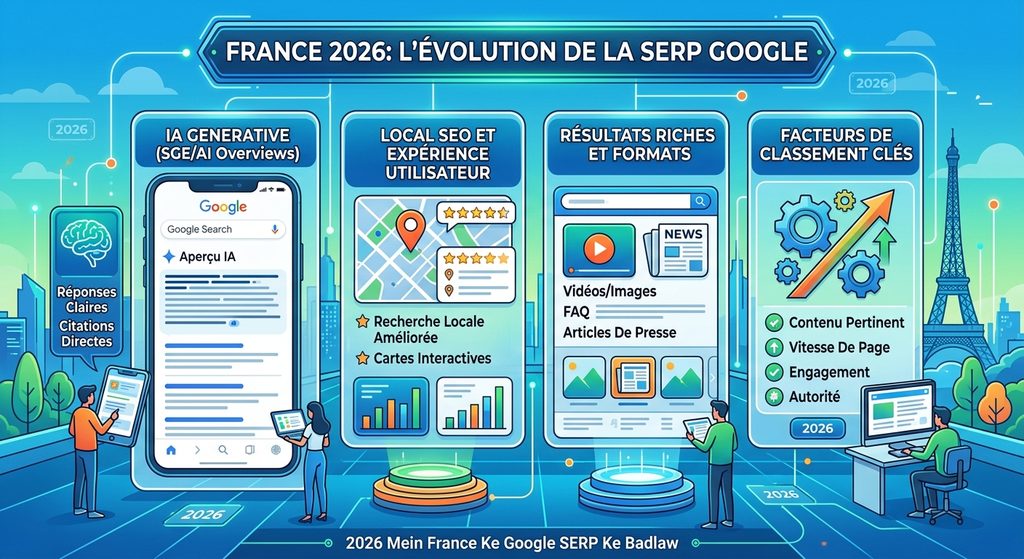
One of the most important developments for French search visibility is the arrival of Google’s AI Overviews in France.
SE Ranking reported in August 2026 that AI Overviews were appearing for more than 52% of the 100,000 French keywords included in its study. Its analysis also reported that approximately 60.46% of cited pages came from the organic top 10, while about 90.39% of cited domains appeared somewhere in the organic top 50.
These numbers should be treated as findings from that particular study rather than a universal percentage for every French search. Nevertheless, they show why modern Serp France analysis needs to look beyond conventional blue-link rankings.
AI visibility is becoming another measurement
A page can now have several forms of search visibility:
- Traditional organic ranking
- Featured snippet visibility
- People Also Ask visibility
- Local search visibility
- Image or video visibility
- AI Overview citation
- Brand visibility
This changes how SEO reporting should be interpreted.
Instead of saying “we moved from position 8 to position 5,” a stronger report might explain that organic visibility improved, the page gained a featured result, impressions increased, or the brand began appearing in AI-generated answers.
French sources can be valuable
The 2026 French AI Overview research found that 89.34% of cited sources in its dataset were in French. It also reported particularly high French-source representation in areas such as law, finance, real estate, and insurance.
This reinforces an important localization principle: when targeting France, producing genuinely useful French-language information can matter beyond traditional keyword matching.
Common Serp France SEO Mistakes to Avoid
A strong strategy can still fail if the measurement or content process is flawed. Several mistakes appear repeatedly in international SEO campaigns.
Mistake 1: Checking rankings from the wrong country
A ranking collected from the US does not necessarily represent French visibility. Use a French search environment for French SEO decisions.
Mistake 2: Treating one ranking as the whole story
A position number does not explain impressions, clicks, conversions, SERP features, or brand visibility.
Track multiple metrics together.
Mistake 3: Translating without localization
Literal translation can produce unnatural wording and miss important differences in search behavior.
Research the French market independently instead of treating French content as an English page translated into another language.
Mistake 4: Stuffing the primary keyword
Repeating “Serp France” in every paragraph does not make the page more relevant. Keyword stuffing can also make the article difficult to read.
Use the keyword naturally and cover related concepts comprehensively.
Mistake 5: Publishing without an author
Anonymous content can make it harder for readers to understand who stands behind the information. Where appropriate, use a clear byline and link it to an author profile.
Mistake 6: Creating content only for word count
A 2,500-word article is not automatically better than a 1,200-word article. Google explicitly states that creators should not write to a particular word count simply because they believe Google prefers that length.
The correct target is enough content to answer the user’s question thoroughly.
Mistake 7: Adding links just for SEO
A paragraph containing five unrelated links does not automatically create a strong internal-linking structure.
Links should appear where they help the reader understand another relevant page. Google recommends concise, descriptive anchor text and warns against forcing keywords into anchors.
How Can You Build a Strong Serp France Strategy?
A sustainable strategy should combine research, content, technical SEO, authority, and measurement.
Start with the keywords that matter commercially or strategically. Group them by intent and identify which searches require informational articles, service pages, category pages, product pages, or local landing pages.
Then examine the French SERP for each important group. Record the dominant content formats and identify what competing pages do well and what they fail to explain.
Next, build content that fills genuine gaps. Include useful examples, accurate information, clear explanations, original observations where available, and links to trustworthy sources.
After publication, monitor the page rather than assuming the work is finished.
A practical monthly workflow
A simple monthly process can look like this:
Week 1: Review keyword rankings and identify significant gains or losses.
Week 2: Study important French SERPs and check competitors.
Week 3: Update pages with declining visibility, outdated information, or weak intent matching.
Week 4: Review Search Console performance, internal links, conversions, and new content opportunities.
This creates a continuous improvement cycle rather than a one-time SEO project.
Serp France Tracking vs Traditional Global Rank Tracking
| Feature | Global Rank Tracking | Serp France Tracking |
|---|---|---|
| Country | Multiple or unspecified | France |
| Language | May vary | French-focused |
| Location | Often broad | France, city, or region |
| Search intent | General | French market-specific |
| Local results | May be overlooked | Important where relevant |
| Competitors | Global | French-market competitors |
| SERP features | General | French SERP features |
| AI visibility | May be aggregated | France-specific analysis |
The advantage of a dedicated Serp France approach is context.
Suppose your website ranks position 5 globally but position 18 in France. A global report may hide the problem. French tracking shows exactly where the opportunity exists.
This is particularly useful for businesses expanding into France because it prevents teams from assuming that success in another country automatically transfers to the French market.
How Do You Troubleshoot a Sudden French Ranking Drop?
A ranking decline should be investigated systematically rather than immediately blaming an algorithm update.
First, check whether the decline affects one URL or many pages. If one page falls, examine its content, internal links, indexing status, competitors, and search intent.
If hundreds of pages decline simultaneously, investigate broader technical changes, indexing problems, site migrations, robots directives, canonical tags, server errors, and major changes to the website.
Check Google Search Console
Search Console can help you compare clicks, impressions, CTR, and average position over time.
If impressions remain stable but clicks fall, investigate titles, SERP layout changes, and search features. If impressions and rankings both fall, investigate relevance, competition, indexing, and technical changes.
Compare the French SERP itself
Search results may change even when your website has not.
A new feature, stronger competitor, local pack, video result, or AI Overview can alter the amount of attention available to traditional organic listings.
That is why the actual Serp France environment should be part of troubleshooting.
Avoid making too many changes at once
If you rewrite the title, change the URL, replace half the content, alter internal links, and redesign the page simultaneously, it becomes difficult to know which change helped or hurt.
Make controlled improvements where possible and monitor the results over a reasonable period.
Frequently Asked Questions About Serp France
What is Serp France?
Serp France refers to search engine results viewed for the French market. It is useful for analyzing how websites rank for French users and understanding country-specific SERP features, competitors, and search behavior.
Why are my Google rankings different in France?
Rankings can differ because Google considers factors such as location, language, device, query intent, and the available results. Local searches can show particularly strong geographic variation.
Should I use French keywords or translate my existing keywords?
You should research French keywords independently. Translation can be a starting point, but it does not guarantee that French users search with the same wording or intent.
Does ranking in France require a .fr domain?
No. A .fr domain is not an absolute requirement for ranking in France. A non-.fr website can compete successfully when its content, relevance, technical setup, authority, and localization are appropriate for the French market.
How often should I track Serp France rankings?
Weekly tracking is sufficient for many websites, while highly competitive projects may benefit from more frequent monitoring. The most important factor is consistency in location, language, device, and keyword selection.
Can internal links improve French SEO?
Internal links can help users and search engines discover relevant pages and understand the relationship between topics. Use natural, descriptive anchor text and link pages where the destination genuinely helps the reader.
Does E-E-A-T directly increase rankings?
E-E-A-T is not a single ranking factor. Google describes it as a concept used to understand qualities such as experience, expertise, authoritativeness, and trustworthiness, with trust being particularly important.
Do AI Overviews replace traditional SEO in France?
No. Traditional organic visibility remains important, and current French research indicates substantial overlap between highly ranked organic pages and pages cited in AI Overviews. AI visibility should be treated as an additional part of modern search visibility rather than a replacement for SEO.
Final Thoughts on Serp France
A successful Serp France strategy is not simply about reaching position one for a French keyword. It is about understanding what French users search for, what Google displays for those searches, which competitors already satisfy the intent, and how your website can provide something genuinely useful.
The strongest approach combines French keyword research, localized content, technical SEO, internal linking, credible external references, author transparency, and continuous SERP monitoring. These elements work together to create a website that is easier for both users and search engines to understand.
The French search environment is also changing quickly. The arrival of AI Overviews means that SEO visibility increasingly includes traditional rankings, SERP features, and opportunities to be cited in AI-generated answers. Current research suggests that strong organic visibility remains closely connected with AI citation visibility, making high-quality, authoritative content more important rather than less important.
Most importantly, do not build your strategy around keyword repetition or an arbitrary word count. Google recommends people-first content that demonstrates real value, originality, expertise, and trust, while its link guidance emphasizes useful crawlable links and descriptive anchor text.
If your goal is to improve Serp France visibility, start by measuring the French SERP accurately, identify the pages and queries with the greatest opportunity, improve content based on genuine user needs, strengthen relevant internal links, cite trustworthy sources, and keep evaluating the results over time. That approach gives your website a much stronger foundation for sustainable French search visibility.
