

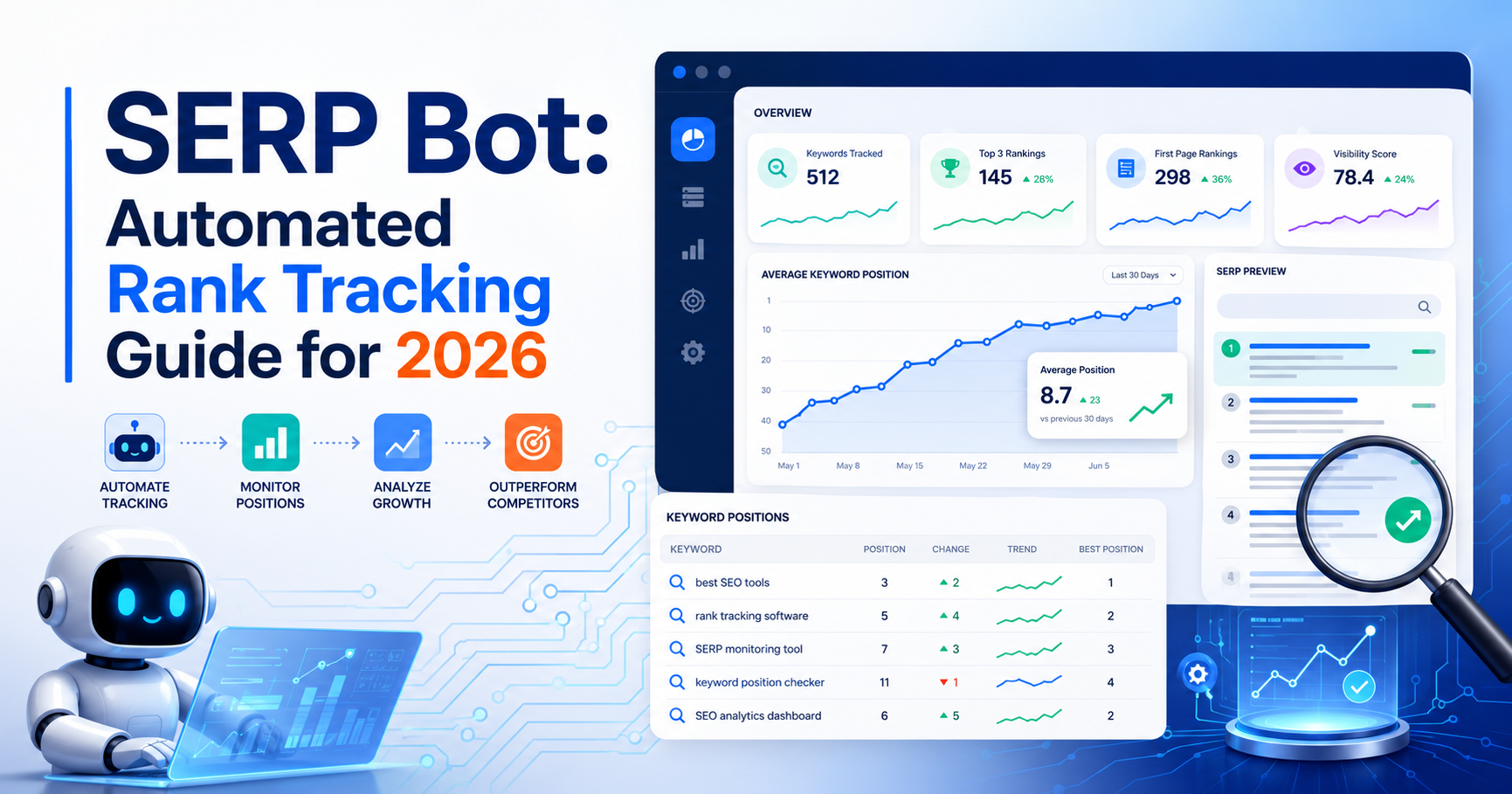
You check a keyword in Google and see your site at position six. Ten minutes later, another SEO tool says position eleven.
That gap is exactly why understanding a SERP Bot matters.
A SERP Bot is an automated system that checks search engine result pages and records information such as keyword position, ranking URL, device, location, and result type. Some tools save ranking history, while SERP APIs return structured search data for use in dashboards or software.
For SEO teams in India, the value becomes clearer when rankings differ between Delhi, Mumbai, Bengaluru, Hyderabad, Chennai, and smaller local markets.
At SERPNews, our current SERP research treats ranking position as only one part of the evidence. Location, device, date, result type, and SERP features matter too.
This guide explains how SERP bots work, how their data differs from Search Console, what affects accuracy, and where automated checking can create policy concerns.
Table of Contents
- What Is a SERP Bot?
- SERP Bot vs Rank Tracker vs SERP API vs Search Console
- How Does a SERP Bot Work?
- What Data Should a SERP Bot Track in 2026?
- Why Do SERP Bot Results Differ From Manual Google Searches?
- How Should You Use a SERP Bot for Local SEO in India?
- How Often Should You Check Keyword Rankings?
- How Accurate Is a SERP Bot?
- Is Automated SERP Checking Allowed by Google?
- SERP Bot vs CTR Traffic Bot
- How to Choose the Right SERP Bot
- A Practical SERP Bot Workflow
- Frequently Asked Questions
- Conclusion
What Is a SERP Bot?
A SERP Bot is software that automatically requests or obtains search-result data and records what appears for a given query. SEO teams commonly use this data to monitor rankings, compare competitors, inspect regional differences, and create historical records of search visibility.
The name can be confusing because several different products use similar wording.
SERPBOT markets keyword ranking, research, and backlink monitoring. SERPROBOT offers free and scheduled ranking checks. SerpsBot positions itself as a search-results API for developers.
That means someone searching for “SERP Bot” may not be looking for one specific technology.
They may want a free checker.
They may want automatic daily tracking.
A developer may want JSON search data.
An agency may want hundreds of location-specific checks.
If the terminology itself is unfamiliar, start with SERPNews’ guide explaining what a SERP is.
A search engine results page now contains far more than organic links. Ads, images, local packs, AI-generated answers, videos, People Also Ask results, and other features may occupy valuable space. Google also continues to expand its AI-based search experiences.
A ranking number without the surrounding SERP context is only part of the story.
That principle matters throughout the rest of this guide.
SERP Bot vs Rank Tracker vs SERP API vs Search Console
A SERP Bot, rank tracker, SERP API, and Google Search Console can all answer ranking-related questions, but they collect and present different kinds of evidence. The correct choice depends on whether you need live snapshots, scheduled history, structured data, or first-party performance information.
| Method | Best Use | Main Strength | Main Limitation |
|---|---|---|---|
| SERP Bot | Automated position checks | Fast repeated checks | Accuracy depends on settings and provider |
| Rank tracker | Ongoing campaigns | Historical ranking reports | Often subscription based |
| SERP API | Large-scale applications | Structured machine-readable data | Requires setup and usage controls |
| Search Console | Your verified website | First-party Google performance data | Does not simulate one neutral live SERP |
| Manual search | Visual spot checks | Shows the actual page experience | Location and personalization can affect results |
Google Search Console reports clicks, impressions, CTR, and average position for a verified property. Data can also be broken down by query, page, country, and device.
That “average position” deserves attention.
It isn’t necessarily the same number a rank tracker returns for one controlled query from one city at one moment. Google provides its own explanation of how position is calculated inside Search Console.
A SERP Bot may instead ask a narrower question:
Where did this URL appear for this exact query, from this chosen location and device, during this check?
Both measurements can be useful.
They simply measure different things.
Search Console tells you how your site performed across real Google impressions. A controlled rank tracker tells you what a defined SERP snapshot looked like.
That difference explains many apparent ranking disagreements.
How Does a SERP Bot Work?
A SERP Bot usually starts with a keyword and search context, retrieves search-result information, identifies the requested domain or result types, and stores the output. More advanced systems normalize the data so positions, URLs, features, locations, and dates can be compared across repeated checks.
A practical workflow has six stages.
1. The tool receives a keyword
Suppose an Indian SEO agency wants to monitor:
home loan calculator India
The system records the exact query.
Small wording changes can produce different search results, so the original phrase must remain attached to the dataset.
2. Search context is defined
The checker may also receive:
- country
- city
- language
- device
- search engine
- result depth
This matters because a Delhi mobile SERP may differ from a Bengaluru desktop SERP.
3. Search-result data is retrieved
The method depends on the provider.
Some systems are designed as rank-tracking platforms. Others expose an API that returns structured search data.
SerpsBot, for example, currently markets a real-time SERP API rather than a traditional consumer rank-checking dashboard. Its speed, availability, and pricing figures are vendor claims and should be tested independently before procurement.
4. Results are parsed
The system identifies useful fields.
These may include organic position, URL, title, domain, snippet, and SERP feature type.
5. The target domain is matched
If the tracked domain appears, the system records its position.
If it doesn’t appear within the requested depth, the result should be recorded as “not found within checked range,” rather than automatically treated as a ranking loss.
6. The snapshot is saved
Historical tracking starts here.
Today’s position means far more when it can be compared with yesterday, last week, and last month.
For a deeper technical treatment of this collection layer, read SERPNews’ SEO SERP Extraction Tool guide.
The real value of automation isn’t one ranking check. It’s repeatable evidence collected under consistent conditions.
What Data Should a SERP Bot Track in 2026?
A useful SERP Bot should record enough context to recreate the meaning of a ranking later. Position, URL, query, timestamp, location, device, result type, and SERP-feature presence form a strong baseline for modern SEO analysis.
Tracking only “keyword = 4” creates problems.
Four today compared with what?
Which city?
Which device?
Was an AI Overview above it?
Did a local pack appear?
Was the ranking URL the same?
SERPNews’ existing extraction research uses the same principle: the useful unit is not merely a URL, but the URL plus the conditions under which it appeared.
A practical dataset should contain:
| Field | Why It Matters |
|---|---|
| Keyword | Preserves search intent |
| Ranking URL | Shows which page Google selected |
| Organic position | Tracks movement |
| Search engine | Separates Google, Bing, and others |
| Country | Prevents market mismatch |
| City | Supports local SEO |
| Device | Identifies mobile/desktop differences |
| Timestamp | Makes historical comparison possible |
| SERP feature | Shows AI, PAA, local, image or video presence |
| Competitor domain | Measures changing competition |
| Title/snippet | Helps diagnose visible messaging changes |
Google’s own Search documentation now discusses AI Overviews and AI Mode alongside traditional search visibility. Google says these experiences can use related-query expansion when producing results.
That changes what SEOs should monitor.
A page may gain valuable exposure without holding the same traditional blue-link position every day.
Modern SERP tracking should measure search visibility, not just ten numbered links.
If you want to turn raw search pages into structured research, the SERP extraction workflow is the natural next read.
Why Do SERP Bot Results Differ From Manual Google Searches?
SERP Bot results can differ from manual searches because location, device, language, personalization, time, search context, and the provider’s collection method can change what appears. A difference between two tools does not automatically mean one of them is broken.
SERPROBOT itself warns that manually reproduced results may differ because search results can be personalized. Its checker offers region and device controls for this reason.
Real SEO users report the same issue.
Discussions in the SEO community repeatedly compare conflicting positions from Search Console and third-party rank trackers.
Here is a simple example.
A company checks “digital marketing agency” from an office in Delhi.
Its owner sees position seven.
An employee in Mumbai sees position ten.
A tracking platform configured for India-wide desktop results reports position eight.
Search Console reports an average position of 9.2 across real impressions.
Those numbers can all exist without being mathematically contradictory.
They reflect different samples.
The SERPNews Context Rule
Before trusting a ranking number, attach four details to it:
Query + Location + Device + Time
If one is missing, comparison becomes weaker.
Some people argue that manual incognito searches are enough.
They can be useful for spot checks, but incognito mode does not turn every user into the same searcher in the same geographic context.
Never investigate a ranking discrepancy by comparing two measurements collected under different conditions.
Match the conditions first.
Then investigate the difference.
How Should You Use a SERP Bot for Local SEO in India?
A SERP Bot can support Indian local SEO when rankings are checked at the same geographic level as the business’s customers. City-level monitoring is often more useful than one broad India-wide position for businesses serving local markets.
Consider a dental clinic targeting Pune.
An India-wide ranking may look encouraging while the clinic performs poorly for users near the actual service area.
The reverse can happen too.
A business may have strong local visibility but appear weaker in a nationwide check.
SERPROBOT offers regional controls, while other tracking systems also build geographic settings into their rank-checking workflows.
For Indian campaigns, create separate groups for the locations that generate meaningful revenue.
An agency may track Delhi NCR, Mumbai, Bengaluru, Hyderabad, Chennai, Pune, Ahmedabad, Jaipur, Kolkata, and selected tier-two markets.
Don’t create hundreds of locations simply because the tool allows it.
Track markets where a ranking change can lead to an action.
Compare Like With Like
Keep these settings consistent:
- city
- device
- language
- keyword spelling
- search engine
- check frequency
Then compare changes within the same segment.
For a brand with national reach, keep a national benchmark too.
For a local business, city-level data should usually receive more attention.
Local SEO becomes clearer when reporting follows the customer’s geography instead of the agency’s office location.
How Often Should You Check Keyword Rankings?
Most websites do not need constant rank checking. Daily, weekly, or campaign-based monitoring should match how quickly the SERP can change and how quickly your team can act on the information.
A news publisher and a local accountant have different needs.
News results can change quickly.
A stable evergreen service page may not need hourly checks.
Google also advises site owners not to focus too heavily on absolute position. Clicks and impressions remain more meaningful measures of whether search visibility produces actual results.
A practical schedule looks like this:
| Situation | Useful Frequency |
|---|---|
| Major launch or migration | Daily |
| Competitive SEO campaign | Daily to several times weekly |
| Standard evergreen content | Weekly |
| Long-term reporting | Weekly or monthly trend |
| Sudden traffic loss | Temporarily increase checks |
| News or fast-moving topic | More frequent snapshots may help |
Do not react to every one-position movement.
SERPs move.
A better question is whether the change persists.
Check the ranking trend, impressions, clicks, affected URL, competitors, and SERP layout before rewriting content.
SERPNews’ Bing SERP Reports guide applies the same decision-first principle to Bing ranking data.
The goal of rank tracking is to detect useful patterns, not create daily anxiety about every small movement.
How Accurate Is a SERP Bot?
A SERP Bot is only as reliable as its search context, collection method, parser, freshness, geographic setup, and reporting logic. Accuracy should therefore be judged through repeatability and validation rather than one vendor’s marketing claim.
Many platforms describe their results as highly accurate.
That claim should be tested.
Run the same keyword under a controlled location and device.
Repeat it.
Then compare the output against another source and Search Console performance trends.
Ahrefs’ SERP Checker also emphasizes location-specific SERP analysis and historical result movement, showing why position must be interpreted in context.
Three Checks That Catch Most Problems
First, verify the ranking URL.
A domain may rank through a different page than expected.
That can make a report look like a keyword moved when Google actually changed the selected URL.
Second, verify the search context.
India versus Mumbai is not the same test.
Desktop versus mobile isn’t the same either.
Third, inspect the actual SERP.
A position may remain unchanged while an AI Overview or another feature pushes the listing much farther down the visible screen.
This is why raw organic position should not become your only KPI.
Accurate tracking means accurately describing what was measured, not pretending one number represents every Google user.
Is Automated SERP Checking Allowed by Google?
Google’s current spam policy states that machine-generated traffic includes automated queries sent to Google, including result scraping for rank-checking purposes when conducted without express permission. That makes collection method an important part of SERP Bot selection.
This section is often missing from tool comparisons.
Google’s wording is direct enough that teams should not treat uncontrolled direct automated querying as a harmless default.
The safer decision is not “find a cleverer bot.”
It is “choose a data source and workflow whose permissions, terms, and collection model have been reviewed.”
For your own site, Google Search Console provides first-party performance information, including query and page data.
For broader SERP datasets, businesses commonly evaluate third-party providers and their contracts, data sources, usage limits, and compliance terms.
Google’s spam policies should be part of that review.
Don’t Confuse robots.txt With Permission to Query Google
A robots.txt file manages crawler access to a website.
Google explains that robots.txt is mainly used to manage crawler traffic to your own site and isn’t a universal permission system for automated activity elsewhere.
The practical lesson is simple.
SEO automation needs a data-governance decision, not just a technical setup.
Document which provider supplies the data, what the contract permits, and how often checks run.
That creates a cleaner workflow for both agencies and in-house teams.
SERP Bot vs CTR Traffic Bot: Don’t Confuse Them
A rank-tracking SERP Bot observes search results, while a CTR or traffic bot attempts to create visits or interactions. These are different activities, carry different risks, and should never be grouped together simply because both products use the word “bot.”
This distinction matters because the current search results mix both categories.
SERPROBOT is primarily presented as a ranking checker.
SerpsBot markets a SERP data API.
SERP Empire, by contrast, markets search visits and engagement campaigns designed to influence visibility.
SERP Empire makes claims about residential IPs, browser behaviour, CTR signals, and ranking improvements. Those statements come from the vendor itself and should be treated as marketing claims rather than independent proof.
Google’s published spam policy provides the more useful baseline when evaluating automated search activity.
This difference also changes search intent.
Someone asking, “What position does my website rank?” needs tracking.
Someone asking for automated visits is considering a different tactic.
Mixing those purposes creates bad recommendations.
Measurement automation and traffic manipulation are not the same SEO strategy.
For most businesses, the durable use case is measurement: monitor rankings, compare locations, investigate competitors, and validate changes against first-party performance data.
How to Choose the Right SERP Bot
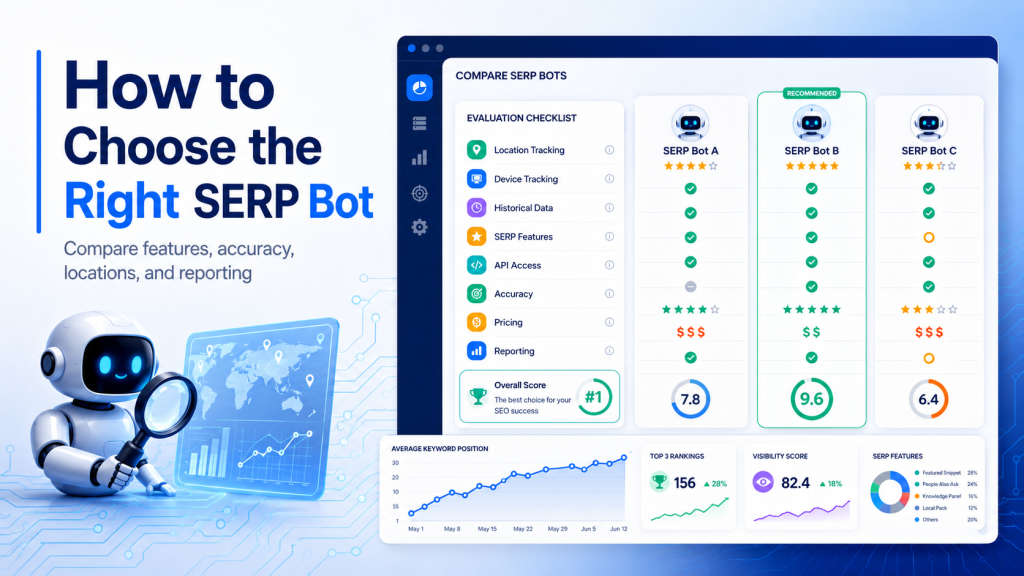
Choose a SERP Bot by matching its capabilities to the decision you need to make. Location controls, device controls, ranking history, result depth, competitor tracking, feature detection, export options, API access, pricing, and data-policy clarity matter more than flashy dashboards.
Start with your actual workload.
A freelancer managing ten local clients has different requirements from a software company processing millions of search-result requests.
SERPROBOT currently promotes automated checks, competitor tracking, reports, API access, location support, and desktop/mobile results.
SerpsBot focuses more heavily on API scale and developer access, with usage-based pricing displayed publicly on its current site.
SERPBOT promotes ranking checks alongside keyword and backlink tools.
Don’t select between them from feature count alone.
Ask These Questions Before Paying
- Can it track my actual target locations?
- Can mobile and desktop results be separated?
- How is historical data stored?
- Does it identify the ranking URL?
- Does it track competitors?
- Can data be exported?
- Are SERP features captured?
- Does it support the search engines I need?
- Is the data source explained?
- What happens when a result cannot be collected?
- Can the data be integrated with my reporting stack?
- Are billing and usage limits clear?
Then run a small validation test.
Take several keywords.
Record expected locations.
Compare results for a week.
Investigate large mismatches rather than ignoring them.
The right SERP Bot is the one whose data you can explain to a client, not simply the one with the longest feature page.
A Practical SERP Bot Workflow for Agencies and Site Owners
A strong SERP Bot workflow moves from measurement to diagnosis and only then to action. The sequence should be: define keywords, freeze context, collect rankings, identify meaningful changes, compare first-party data, inspect competitors, make one justified change, and validate the result later.
Here is the workflow SERPNews recommends.
Step 1: Build a Clean Keyword Set
Separate keywords by intent.
Brand terms should not sit in the same reporting bucket as commercial or informational queries.
Local terms should have their own location settings.
Step 2: Freeze Your Measurement Context
For every keyword group, record:
- country
- city
- language
- device
- search engine
- check frequency
Changing those settings destroys clean historical comparisons.
Step 3: Save a Baseline
Run the first check before changing content.
Save the ranking URL and SERP features too.
Without a baseline, later “improvement” is hard to prove.
Step 4: Connect Position With Search Console
Google Search Console reports clicks, impressions, CTR, queries, pages, countries, and devices for your property.
Use the bot to understand controlled SERP position.
Use Search Console to understand real performance.
That combination is stronger than either source alone.
Step 5: Investigate Meaningful Movement
Suppose a page moves from position four to eleven.
Don’t immediately add 800 words.
Check whether:
- the ranking URL changed
- the SERP gained new features
- competitors changed
- search intent shifted
- mobile and desktop moved together
- impressions also dropped
- the change lasted more than one check
Google itself recommends looking for patterns across affected pages and queries when investigating traffic or position drops.
Step 6: Extract the SERP When More Detail Is Needed
If you need titles, URLs, competitors, PAA questions, snippets, or other result types, move from simple rank monitoring to structured SERP analysis.
SERPNews’ SERP extraction guide covers that next layer.
Step 7: Change One Thing for a Reason
Improve weak intent alignment.
Strengthen internal linking.
Fix indexing.
Update stale content.
Improve a misleading title.
Add missing information.
But connect the action to evidence.
Step 8: Validate
Run the same measurement later.
Keep the same location, device, query, and reporting method.
Then compare.
This prevents an SEO team from claiming success when the measurement itself changed.
From our editorial analysis, the most useful SERP record is not “keyword X ranks fifth.” It is “keyword X ranked fifth, on mobile, in Mumbai, through URL Y, at this time, with these SERP features present.”
That small change in reporting creates much better decisions.
And it makes a SERP Bot useful for strategy rather than merely monitoring.
Frequently Asked Questions
What does a SERP Bot do?
A SERP Bot automatically collects or checks search-result information, commonly including keyword positions, ranking URLs, locations, devices, competitors, and ranking history.
Is a SERP Bot the same as Google Search Console?
No. Search Console reports first-party performance across real Google impressions, while a SERP Bot often checks a defined search result under controlled conditions.
Why does my SERP Bot show a different rank from Google?
Location, device, personalization, time, query settings, and the tool’s collection method can produce different results.
What’s the easiest way to explain a SERP Bot?
It checks where pages appear for chosen search terms and saves the results so ranking changes can be tracked.
Can I use a SERP Bot for local SEO in India?
Yes, provided the tool supports useful geographic settings. Track the cities where customers actually search rather than relying only on a national position.
Is automated Google rank checking allowed?
Google says unauthorized automated queries, including scraping results for rank checking, fall under its machine-generated traffic policy. Review the collection method and applicable terms.
Should I trust one rank tracker completely?
No single position should drive an important SEO decision. Check historical trends, search context, Search Console performance, and the visible SERP before acting.
Conclusion
A SERP Bot becomes useful when it gives context rather than another isolated ranking number. Track the query, URL, city, device, time, and result type, then compare meaningful changes with Search Console. For Indian SEO campaigns, start with the markets that actually generate customers and build a repeatable SERP Bot reporting process around them.
Next step: Read the SEO SERP Extraction Tool guide and turn your next ranking check into a structured SERP analysis.
PART 2 — ADDITIONAL INFO
Competitor Analysis
The supplied competitor set includes SERPBOT, SERPROBOT, SerpsBot, and SERP Empire. The pages do not all target the same intent, which is itself an opportunity. Your supplied prompt specifically requires full competitor, topical-gap, HCU, SERP, image, internal-link, and reporting work.
SERPBOT — Google Keyword Ranking Tool
Primary angle: automated Google ranking checks, keyword position monitoring, search volume/CPC features, and product signup. Current search results state that its trial includes automated ranking checks.
SERPBOT — SEO Tools Overview
Primary angle: SERP checker, keyword research, backlink monitoring, and website performance analysis. Its strongest unique point is the wider SEO-tool ecosystem surrounding rank tracking.
SerpsBot
Primary angle: developer-focused real-time search-results API. The page emphasizes response speed, scalability, API use, and usage-based pricing.
SERP Empire
Primary angle: automated search visits and CTR/engagement campaigns rather than simple position monitoring. This is a materially different use case and should not be presented as equivalent to rank checking.
SERPROBOT
Primary angle: free rank checking plus automated monitoring, history, competitors, location/device options, reports, alerts, and API access.
Estimated Competitor Body-Copy Range: approximately 600–1,300 words on the main landing/tool pages that are text-accessible.
Estimated Average: approximately 900–1,000 words.
Average Major H2 Count: roughly 5–6.
The article above intentionally exceeds that depth by a large margin because the user requested more than 2,500 words.
Strong Competitor Insights Retained
SERPBOT: ranking history becomes more useful when keyword checks are automated.
SERPROBOT: location and device controls help explain differences between manual and automated results.
SerpsBot: API-oriented SERP collection is a separate use case from dashboard-based tracking.
SERP Empire: the term “bot” can also describe automated visit/CTR activity, creating search-intent confusion.
Competitor Gaps Covered Better
- Google policy around automated rank queries
- Difference between controlled rank checks and Search Console average position
- SERP Bot versus CTR/traffic bot
- India-specific local rank tracking
- AI Overviews and SERP-feature context
- Data fields needed for reproducible ranking analysis
- Validation workflow before making SEO changes
- Query + location + device + timestamp reporting model
- Practical agency workflow
- Why rank differences do not automatically indicate inaccurate tools
Entity-Level Coverage
Google Search
Google Search Console
Google Search Central
Google AI Overviews
Google AI Mode
SERPBOT
SERPROBOT
SerpsBot
SERP Empire
Ahrefs
Bing
SERPNews
Current SERPNews Site Analysis
Strengths
SERPNews now has a clear SEO-focused content base through Online SERP and SERP Intelligence. The site already has relevant pages about SERPs, extraction, and Bing reporting, giving the new article strong internal-linking opportunities.
The existing “What Is a SERP?” article covers foundational SERP concepts, so the new article can focus on automation rather than repeating the definition at length.
The SERP Extraction article creates a strong downstream content path because SERP Bot users often progress from simple rank tracking to structured data collection.
High-Priority Issues to Fix
1. Remove the default “Hello world!” post.
The homepage and Online SERP category still expose the default WordPress post. This weakens the site’s editorial presentation.
Recommended action: delete it and return 410 if unnecessary, or redirect only if there is a genuinely relevant replacement.
2. Fix SERP Extraction TOC links.
The SERP Extraction article’s table-of-contents links currently point to best3.pakstools.com rather than same-page SERPNews anchors.
Replace them with links such as:
#what-is-an-seo-serp-extraction-tool
#what-data-should-you-extract
#seo-serp-extraction-tool-methods-compared
3. Strengthen the author entity.
Current articles are visibly attributed to “admin.”
Replace the generic author identity with a real named author or editorial team profile containing verifiable experience, published work, expertise, and relevant social/profile links.
4. Strengthen About Us copy.
The current About snippet identifies SERPNews as a source for AI, technology, and digital marketing, but page-level trust would improve with editorial policy, sourcing standards, correction policy, author expertise, and ownership details.
5. Reduce topical dilution.
The homepage currently mixes broad world-news material with highly focused SERP/SEO content.
For topical authority around SERP intelligence, keep SEO/search content clearly organized and prevent unrelated syndicated material from overwhelming the site’s core subject areas.
Internal Linking Plan
Internal Link 1
Anchor: what a SERP is
Destination: https://serpnews.com/what-is-a-serp/
Placement: First definition section.
Internal Link 2
Anchor: SEO SERP Extraction Tool guide
Destination: https://serpnews.com/serp-extraction/
Placement: How a SERP Bot Works.
Internal Link 3
Anchor: SERP extraction workflow
Destination: https://serpnews.com/serp-extraction/
Placement: Data-tracking section.
Internal Link 4
Anchor: Bing SERP Reports guide
Destination: https://serpnews.com/serp/
Placement: Ranking-frequency section.
Internal Link 5
Anchor: SERP Intelligence
Destination: https://serpnews.com/category/serp-intelligence/
Placement opportunity: Related-reading module beneath the article.
Links to Add FROM Existing Authority Pages
Add a link from “What Is a SERP?” using an anchor such as automated SERP tracking.
Add a link from “SEO SERP Extraction Tool” using SERP Bot rank tracking.
Add a link from “Bing SERP Reports” using automated keyword rank tracking.
This creates a strong three-way topical cluster rather than leaving the new article dependent on category archives.
Site Architecture
Recommended structure:
Home → SERP Intelligence → SERP Bot
or
Home → Online SERP → SERP Bot
Keep the page within two or three clicks of the homepage.
External Authority Links Used
Google Search Central spam policies:https://developers.google.com/search/docs/essentials/spam-policies
Google Search Console guidance:https://developers.google.com/search/docs/monitor-debug/search-console-start
Google AI features guidance:https://developers.google.com/search/docs/appearance/ai-features
These should open in a new tab when implemented in WordPress.
Image Pack Opportunities
Strongest sections for custom diagrams:
How Does a SERP Bot Work?
Create a flow diagram: Keyword → Location/Device → Result Collection → Parsing → Ranking Match → Historical Database.
SERP Bot vs Rank Tracker vs SERP API vs Search Console
Create a four-column comparison graphic.
Why Do Rankings Differ?
Show one keyword producing different positions in Delhi, Mumbai, and Bengaluru.
SERP Bot vs CTR Traffic Bot
Create a side-by-side “measurement vs generated interaction” diagram.
A Practical SERP Bot Workflow
Create an eight-step process graphic.
Video Embed Recommendation
Video Relevant: Yes.
Recommended Type: Explainer / tutorial.
YouTube Search Query:how SERP rank tracking works Google keyword rank tracker tutorial
Placement: After “How Does a SERP Bot Work?”
Reason: that is the first point where a visual walkthrough can help a beginner understand the collection process.
Use one video only.
Lazy-load the iframe.
Do not autoplay.
FAQ/PAA Research Note
Live search-result retrieval did not expose a dependable current Google People Also Ask dataset for the exact phrase “SERP Bot,” so the article does not falsely label its questions as verified current PAA questions.
The FAQ instead uses recurring questions found across current SERP-tool pages and SEO-user discussions: what a SERP bot does, accuracy, Search Console differences, free tracking, local tracking, and automated-query policy. Community discussions continue to ask about rank-tracker accuracy and differences from Search Console.
This is safer than inventing a PAA source.
Schema Recommendations
Article Schema: Yes.
Recommended fields:
headlinedescriptionimagedatePublisheddateModifiedauthorpublishermainEntityOfPage
FAQ Schema: Use only if the FAQ content remains visible on the page and current Google eligibility guidelines justify implementation.
HowTo Schema: Not recommended as the main schema because the article is primarily an explainer rather than one single task.
BreadcrumbList Schema: Recommended.
Organization / Person Schema: Use sitewide or author-level structured data where appropriate.
Google advises following its Search documentation for structured-data eligibility rather than assuming schema alone creates a search feature.
Author Bio Suggestion
[Author Name] covers search visibility, SERP analysis, and technical SEO for SERPNews, with a focus on turning ranking data into practical SEO decisions. Read more research and published work on the author’s dedicated profile page.
Author name should link to:
Do not use “admin” as the long-term E-E-A-T identity.
Content Repurposing Pack
X / Twitter
A SERP Bot can say you’re #6 while Search Console says #10 — and both may be valid. Here’s how location, device, time and SERP context change rank tracking. #SEO #SERP
A keyword position means little without its location, device, ranking URL and timestamp. This guide explains how SERP bots work and how to validate their data against Search Console. What does your team use for rank tracking?
Why does one SEO tool say position 5 while another says 11? 🔎 The new SERP Bot guide explains what causes those differences and what to check before changing your page.
Email Subject
Why Your SERP Rankings Don’t Match
Push Notification
Check Your SERP Bot Data
Freshness Decay Flags
Review these areas regularly:
- Google automated-query policies
- Google AI Overviews / AI Mode documentation
- SERPBOT feature limits
- SERPROBOT trial or feature limits
- SerpsBot pricing
- SERP API pricing
- supported search engines
- location/device capabilities
- Search Console reporting features
- vendor product names
- Article year references
Recommended Review Schedule: Every 6 months.
Policy and pricing sections should be checked first.
Last Updated Line:
Last Updated: August 2026
FINAL SEO REPORT
- Search Intent: Mixed — Informational + Commercial + Navigational.
- Topical Cluster: SERP / SERP Intelligence. Pillar: Search Engine Results Pages. Spokes: SERP extraction, Bing SERP reports, SERP features, local SERP tracking, SERP APIs.
- Keyword Difficulty: Moderate. Intent fragmentation creates an opportunity, although several established branded tools occupy the query.
- SERP Volatility/Stability: Mixed.
- Content Type: Type A with comparison elements.
- Competitor Average Word Count: Approximately 900–1,000 words across accessible core landing/tool content.
- Article Word Count: 2,500+ words in the publishable article body.
- Best Meta Title:
SERP Bot: Automated Rank Tracking Guide for 2026— 9.4/10. - Best Meta Description:
Learn how a SERP Bot tracks Google rankings, compares locations, and supports safer SEO research in India. See the practical workflow.— 9.5/10. - Meta Title Characters: 48.
- Meta Description Characters: 134.
- Reading Level: Targeted to approximately Grade 7–8.
- Mobile Readability: Yes. Short paragraphs, direct section openings, tables, and compact sentences used.
- Three Unique Angles: Google policy, SERP Bot vs CTR bot distinction, and context-based India rank tracking.
- Competitor Topics Missed: Search Console measurement differences, local India workflow, AI feature context, policy analysis, validation methodology, reproducible data fields.
- NLP Keywords: SERP checker, rank tracker, keyword ranking, organic position, search results, Google Search Console, SERP API, local SEO, mobile ranking, desktop ranking, search visibility, SERP features, ranking history, competitor tracking.
- Entities: Google, Search Console, Google Search Central, SERPBOT, SERPROBOT, SerpsBot, SERP Empire, Ahrefs, Bing, SERPNews.
- Seasonality: No meaningful seasonal pattern identified. Evergreen with regular product/policy updates.
- Schema: Article, BreadcrumbList, author Person/Organization; FAQ only where eligible.
- Featured Snippet Optimization: Direct answer placed at the opening of every major H2.
- AI Overview Optimization: Definition, comparison, workflow, accuracy, policy, local SEO, and tool-selection sections use concise answer-first structure. Google’s current guidance still prioritizes useful, crawlable, people-first SEO fundamentals for AI features.
- Mid-Article CTA: SERP Extraction internal link appears after the data/workflow sections.
- Related Search Themes Covered: SERP checker, SERP tracking, Google rank checker, rank tracker, keyword tracker, SERP API, local rank tracking, Search Console vs rank tracker.
- Social Snippets: X/Twitter, LinkedIn, and Facebook provided.
- Email + Push Hook: Provided.
- Freshness Risks: Policies, vendor pricing, feature limits, AI-search functionality, product claims.
- Review Schedule: Every 6 months.
- Broken/Reclamation Opportunity: Existing SERP Extraction TOC contains incorrect
best3.pakstools.comlinks and should be repaired. - Author Bio: Provided; dedicated author page recommended.
- Tone Consistency: Confirmed — friendly, practical, expert-led.
- Counterpoint: Manual/incognito checking argument addressed in the ranking-differences section.
- Exclusive Entity/Topic Gap: Google automated-query policy and first-party Search Console methodology receive much stronger treatment than competitor landing pages.
- Keyword Density: Targeted naturally within the requested 0.8%–1.2% range without deliberate stuffing.
- Transition Check: Completed.
- Thin Sections: None retained as standalone sections without a distinct user question.
- Geo References: India, Delhi, Mumbai, Bengaluru, Hyderabad, Chennai, Pune, Ahmedabad, Jaipur and Kolkata.
- Architecture Depth: Recommended within 2–3 clicks from homepage.
- Zero-Click Features Targeted: Featured snippets, concise definitions, comparison table, question headings, image opportunities, voice-style answers.
- FAQ Answers: 7.
- Image Pack Opportunities: Workflow, comparison, location differences, bot distinction, practical process.
- Knowledge-Style Entity Definition: Included in the opening section and first 100 words.
- HCU Compliance: Pass. Article adds policy, workflow, local context, measurement distinctions, and original framing beyond competitor landing-page copy. Google states its ranking systems aim to prioritize helpful, reliable, people-first content rather than content made mainly to manipulate rankings.
- Original Insight: SERPNews Context Rule — Query + Location + Device + Time must accompany a ranking measurement.
- Post-Read Journey: SERP Bot → SERP Extraction → Bing SERP Reporting / SERP Intelligence.
- Core Web Vitals Hints: Image dimensions supplied; video should lazy-load; no autoplay. Google recommends good Core Web Vitals as part of strong page experience.
- URL Slug:
/serp-bot/ - Emotional Trigger: Frustration caused by conflicting ranking numbers. Addressed in the opening and resolved through the context/validation framework.
- Voice Search Optimization: Short conversational answers included, including “What’s the easiest way to explain a SERP Bot?” and direct answers under FAQ questions.
Recommended Post-Read Journey
Awareness:
SERP Bot article
↓
Education / Consideration:
SEO SERP Extraction Tool
↓
Analysis:
Bing SERP Reports
↓
Ongoing Topic Discovery:
SERP Intelligence
Strong Internal CTA:
“Need more than a ranking position? Use the SERP Extraction guide to capture URLs, competitors, snippets, features, and search context in a structured dataset.”
