


You search Google for one simple answer, but the page you get back is anything but simple. There may be an AI Overview, ads, videos, images, questions, maps, products, and the familiar organic results.
That crowded page is exactly why SERP Features matter.
SERP features are enhanced elements that appear on a search engine results page beyond the traditional organic listings. They can answer questions, show images, display businesses, surface products, or summarize information before a searcher visits a website.
In this guide, you’ll learn what the major SERP features are, why they matter in 2026, which ones are realistic targets, and how to build pages that have a better chance of appearing in them.
If you’ve worked with SEO for a while, you already know the old goal: rank in the top 10.
But here’s the thing.
A page can rank well and still receive less attention when the SERP around it is packed with other search features.
Google’s own guidance also makes the modern approach clear: there isn’t a special AI trick required for AI Overviews. Strong technical SEO, useful content, internal linking, good page experience, and accurate structured data remain the foundation.
Table of Contents
- What Are SERP Features?
- Why SERP Features Matter for SEO
- The Main Types of SERP Features
- AI Overviews and the New Search Experience
- How to Win Featured Snippets
- How to Optimize for People Also Ask
- How Images and Videos Create More Search Visibility
- Local, Shopping and Other Commercial Features
- How to Find SERP Feature Opportunities
- A Practical SERP Features Optimization Process
- Common Mistakes That Waste SERP Opportunities
- Frequently Asked Questions
- Conclusion
What Are SERP Features?
SERP Features are search-result elements that go beyond standard organic listings and provide additional information, answers, visuals, or actions directly on the results page. Common examples include AI Overviews, featured snippets, People Also Ask, image packs, video results, local packs, knowledge panels, shopping results, and top stories.
A traditional result usually contains a title, URL, and description. A SERP feature can occupy much more visual space and may answer the searcher’s question without requiring another search.
For example, someone searching for a nearby restaurant may see a map and business listings. A person searching for a definition may see a featured snippet or AI Overview. A product query may produce shopping results.
That means Google isn’t treating every query the same way.
The search result format itself is a clue about what users expect.
According to Semrush Sensor data cited by Backlinko, only 1.16% of Google’s first-page results had no SERP features in March 2026.
This is a useful reminder: SERP features aren’t a side topic anymore. They’re part of the environment your organic listings compete inside.
Why SERP Features Matter for SEO
SERP Features matter because they can increase visibility, change click behavior, and push traditional organic results lower on the page. A page that appears inside a relevant feature can gain attention even when its standard blue-link position isn’t first.
Think about the difference between ranking at position three on a clean SERP and ranking at position three beneath an AI Overview, product carousel, and several other elements.
The numerical ranking is identical.
The actual visibility isn’t.
Ahrefs reports that 99% of keywords in its US database trigger at least one tracked SERP feature, although that figure comes from Ahrefs’ own dataset rather than every Google query worldwide.
This changes how SEOs should measure performance.
Instead of asking only, “What position are we ranking at?” ask:
- Which SERP features appear for our target queries?
- Which competitors own them?
- Can our existing content compete for them?
- How much screen space does each feature occupy?
- Does the feature support clicks, visibility, conversions, or brand discovery?
Ranking is still useful. But ranking alone doesn’t tell the whole search story.
The real SEO opportunity
A SERP feature can sometimes send visitors directly to your page. Other features may create brand exposure without producing an immediate click.
AI Overviews are a good example. Google says AI Overviews and AI Mode can surface links to supporting websites and that standard SEO practices remain relevant for eligibility.
So the goal isn’t simply to “hack” a feature.
The goal is to become a useful source that Google can confidently understand and surface.
The Main Types of SERP Features
The main SERP features include AI Overviews, featured snippets, People Also Ask, knowledge panels, local packs, image packs, video results, shopping results, rich results, sitelinks, discussions and forums, and Top Stories. The exact mix changes according to query, location, device, search intent, and Google’s systems.
| SERP Feature | Typical Intent | Main Opportunity |
|---|---|---|
| AI Overview | Informational | Become a cited source |
| Featured Snippet | Informational | Provide a concise answer |
| People Also Ask | Informational | Answer related questions |
| Image Pack | Visual | Optimize useful images |
| Video Carousel | Informational / How-to | Publish helpful videos |
| Local Pack | Local | Optimize local presence |
| Shopping / Products | Commercial | Improve product data |
| Knowledge Panel | Entity | Strengthen entity signals |
| Top Stories | News | Publish timely reporting |
| Sitelinks | Navigational | Improve site structure |
| Discussions & Forums | Experience-based | Contribute genuine expertise |
The list is not fixed forever. Google continues to change what appears and how it appears.
For example, Backlinko’s 2026 guide identifies AI Overviews, featured snippets, ads, videos, popular products, rich results, sitelinks, PAA, local packs, knowledge panels, image packs, discussions/forums, and Top Stories among the prominent feature types.
AI Overviews and the New Search Experience
AI Overviews are AI-generated summaries that can appear within Google Search and provide a synthesized answer with supporting links. Google says there are no special technical requirements or separate AI-only SEO rules for appearing as a supporting link; pages must meet normal Search requirements and follow helpful, reliable, people-first practices.
This is one area where outdated SEO advice can cause problems.
You don’t need to create strange “AI Overview markup.” Google explicitly says there is no special schema required for AI Overviews or AI Mode.
Instead, focus on fundamentals.
Your page should be:
- Crawlable and indexable.
- Easy to understand.
- Well structured.
- Supported by relevant internal links.
- Accurate and current.
- Written for the person searching.
- Supported by appropriate images or video.
- Marked up with structured data when that markup genuinely applies.
Google also says important content should be available in text and structured data should match the visible content.
That matters for SERPNews because the site’s existing structure already separates Online SERP, SERP Intelligence, SERP Lab, and SERP Features. Strengthening those relationships can make the topical structure easier for both users and search systems to understand.
AI Overviews don’t replace normal SEO
Some SEOs treat AI search as a completely separate discipline.
I don’t think that’s the most useful way to approach it.
The better approach is to make a page genuinely useful enough that it can serve both traditional searchers and AI-assisted search experiences.
Clear answers, strong evidence, useful examples, and good site structure still matter.
How to Win Featured Snippets
Featured snippets are concise passages, lists, or tables that Google may extract from a webpage to answer a query directly. Common formats include paragraph, list, and table snippets.
The first mistake is trying to write “snippet bait.”
Instead, answer the question naturally.
If the heading is “What are SERP features?”, the first paragraph should define SERP features clearly. Don’t make readers scroll through five paragraphs before they reach the answer.
Semrush recommends matching the format of the existing snippet when optimizing for a target query. Paragraph queries should receive concise paragraph answers, while ordered questions may work better with numbered steps.
A simple featured snippet structure
Use this pattern:
Question-based heading
Direct 40–60 word answer.
Short explanation.
Table, numbered steps, or bullets where appropriate.
Supporting examples.
That structure works because it helps humans first.
Don’t forget tables
Tables can be especially useful when a query compares multiple options.
For example, instead of explaining five SERP features across five separate paragraphs, a comparison table can make the differences obvious within seconds.
Google supports structured data for many search appearances, but markup doesn’t guarantee that Google will show a particular rich result.
The safest approach is simple: format information clearly because people need it, then use accurate markup where applicable.
How to Optimize for People Also Ask
People Also Ask, or PAA, is a Google feature that displays related questions and short answers connected to the original query. The questions can expand to reveal additional answers and sources, helping users explore a topic without starting a new search.
PAA is particularly useful for content planning.
Suppose your primary query is “SERP Features.”
The surrounding questions might include:
- What are SERP features?
- Why are SERP features important?
- What are the different types of SERP features?
- How do I optimize for SERP features?
- What is the difference between SERP features and rich snippets?
- Can SERP features reduce organic clicks?
Those questions reveal the information users expect around the main topic.
Write answers that can stand alone
A good PAA answer doesn’t need five paragraphs to make sense.
Start with the direct answer.
Then add the context.
For example:
Are SERP features good for SEO?
SERP features can increase search visibility when your page earns a relevant placement, but some features can also reduce clicks to traditional listings by answering a query directly.
That’s enough to satisfy the immediate question.
Then the article can explain why.
Use your internal cluster
SERPNews already has related content around SERP changes, SERP checkers, SERP bots, extraction tools, and Bing SERP reports.
Those pages shouldn’t sit as isolated articles.
They should support each other.
A reader learning about SERP features may naturally want to know how to check SERPs, monitor ranking changes, or extract results. That’s where internal linking becomes useful rather than decorative.
How Images and Videos Create More Search Visibility
Image and video SERP features give searchers visual ways to consume information, making them especially useful for tutorials, demonstrations, comparisons, and topics where examples are easier to understand visually. Google recommends supporting textual content with high-quality images and videos when appropriate.
For SERPNews, visual content could include:
- Annotated Google SERP screenshots.
- SERP feature diagrams.
- Before-and-after SERP examples.
- Feature comparison charts.
- Short SERP analysis videos.
- Screenshots showing where AI Overviews appear.
- Visual examples of PAA boxes.
Semrush recommends descriptive image filenames, relevant alt text, compressed images, contextual placement, and appropriate image structured data or sitemaps.
A useful visual rule
Don’t add an image just because an SEO checklist says every article needs one.
Add it when the image explains something faster than text.
If the reader can understand the idea in five seconds from a screenshot, use the screenshot.
Video opportunity
A short tutorial showing how to inspect a SERP manually would fit this topic well.
Suggested YouTube search query:
“how to analyze Google SERP features 2026 SEO”
Place one video after the section explaining how to find SERP opportunities.
Lazy-load the embed and don’t autoplay it.
Local, Shopping and Other Commercial Features
Local packs, shopping results, popular products, and other commercial SERP features become especially important when the query shows buying or location intent. These features can place maps, products, prices, ratings, or business information directly into the search experience.
Local SEO is a good example.
A person searching for “SEO agency near me” has a different intent from someone searching “what is SEO.”
Google may respond with a map and local business listings for the first query.
For ecommerce searches, product results may show images, prices, ratings, availability, and merchant information. Google supports Product structured data for eligible product experiences, while Merchant Center data can also help Google understand product information.
Knowledge panels are different
Knowledge panels focus on entities rather than simple webpage answers.
Google explains that knowledge panels can provide information about people, places, companies, and other entities.
That makes entity clarity important for brands.
For SERPNews, consistent brand information across the website, accurate Organization data, clear About information, identifiable authors, and trustworthy external references can all support a stronger entity profile.
Don’t treat entity SEO as a shortcut. Treat it as making your brand easier to understand and verify.
How to Find SERP Feature Opportunities
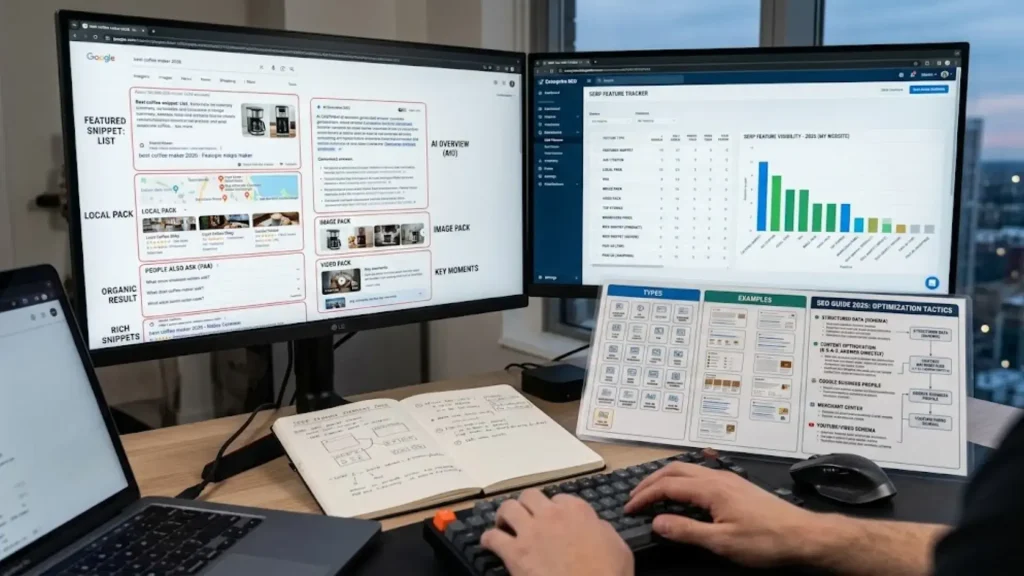
The easiest way to find SERP feature opportunities is to start with the keywords you already target, identify which features appear for them, and compare your visibility with competing pages. This turns SERP features from a vague SEO goal into a measurable content opportunity.
A practical research process looks like this:
1. Start with your existing keywords
Open Google Search Console and identify queries that already generate impressions.
Don’t immediately chase brand-new keywords.
Look for terms where your pages are already close to page one.
2. Check the actual SERP
Search the keyword manually.
Record:
- AI Overview presence.
- Featured snippet.
- PAA.
- Images.
- Videos.
- Local results.
- Shopping results.
- Top Stories.
- Discussions.
- Organic competitors.
The SERP itself tells you what format Google considers useful.
3. Study the feature owner
If another site owns the featured snippet, inspect the exact passage Google is using.
Ask:
What did they answer?
How quickly did they answer it?
Did they use a table?
Did they include a definition?
Is their information outdated?
This isn’t about copying.
It’s about identifying the information gap.
4. Find weaknesses
Look for pages that:
- Miss important subtopics.
- Use outdated examples.
- Have weak definitions.
- Hide the answer deep in the article.
- Lack useful tables.
- Don’t answer related questions.
- Have poor internal linking.
- Use generic images.
That’s where the opportunity starts.
5. Update or create the page
If you already have a relevant page, improve it before creating another one.
Google’s people-first guidance specifically emphasizes adding original value rather than simply rewriting existing sources.
A Practical SERP Features Optimization Process
SERP feature optimization works best as a repeatable process: identify the feature, understand the query intent, match the content format, improve the page, and measure the result. There is no guaranteed formula for winning a feature, so the process should focus on usefulness and relevance rather than tricks.
Step 1: Identify the search intent
Ask whether the searcher wants:
- An answer.
- A definition.
- A comparison.
- A tutorial.
- A local business.
- A product.
- Current news.
The answer determines the feature you’re likely to target.
Step 2: Match the content format
If Google shows a list, consider a useful list.
If Google shows a table, consider a useful table.
If Google shows videos, text alone may not be enough.
If Google shows an AI Overview, focus on clear, factual, well-supported answers.
Step 3: Put the answer first
Don’t hide your strongest information.
The first paragraph under an important heading should answer the question directly.
This is good for users and makes the passage easier for search systems to interpret.
Step 4: Add supporting evidence
Use reliable sources for statistics, product specifications, official policies, and changing information.
For search topics, Google’s own documentation should be one of your first reference points. Its current guidance confirms that people-first content, crawlability, internal linking, page experience, and accurate structured data remain central to modern search visibility.
Step 5: Strengthen internal links
Connect the article with related pages.
For SERPNews, this is particularly important because the site already has multiple SERP-focused articles.
A reader who lands on this guide should have an obvious next step.
For example, after explaining SERP monitoring, link to the site’s SERP Checker guide. After discussing extraction, link to the SEO SERP Extraction Tool article. After explaining broader SERP changes, link to the Google SERP Changes article.
Step 6: Improve the page itself
Check:
- Title.
- Meta description.
- H1.
- H2 structure.
- Internal links.
- Images.
- Alt text.
- Schema.
- Mobile layout.
- Page speed.
- Author information.
- Last updated date.
Step 7: Measure more than rankings
Track impressions, clicks, CTR, conversions, and feature visibility.
A position-one result can still have limited visibility if several large SERP elements appear above it.
seoClarity’s research makes the same broader point: traditional ranking position doesn’t always reflect the actual amount of SERP real estate a page receives.
The better question isn’t “Did we rank?” It’s “How visible were we?”
Common Mistakes That Waste SERP Opportunities
The biggest SERP optimization mistakes are treating every query the same, copying competitors, chasing features without understanding intent, and assuming structured data guarantees a rich result. Google explicitly says structured data can make pages eligible for certain search appearances but doesn’t guarantee that those appearances will show.
Mistake 1: Optimizing without checking the SERP
You can’t know which format works without looking at the actual result page.
Mistake 2: Stuffing the keyword
Repeating “SERP Features” in every heading doesn’t make a page more relevant.
Use related language naturally:
- Google Search.
- Search results page.
- Organic listings.
- Featured snippets.
- Search visibility.
- AI Overviews.
- PAA.
- Rich results.
- Search intent.
- Structured data.
- Organic CTR.
Mistake 3: Assuming schema guarantees visibility
It doesn’t.
Google states that structured data helps systems understand page content and can enable rich results, but the final appearance remains algorithmic.
Mistake 4: Writing only for Google
Google’s current guidance says people-first content should provide original information, substantial value, expertise, and a satisfying experience.
If your article is simply a longer version of the competitor’s article, adding 1,000 words won’t fix the underlying problem.
Mistake 5: Ignoring authorship
A serious SEO publication should make it clear who created the content.
Google specifically recommends clear authorship and author information where readers would expect a byline.
Mistake 6: Publishing and forgetting
SERPs change.
Feature prevalence changes.
Google changes its search interfaces.
Competitors update pages.
Your article should have a review schedule rather than being treated as finished forever.
FAQs
What are SERP features?
SERP features are enhanced search-result elements beyond standard organic listings, including AI Overviews, PAA, featured snippets, images, videos, local packs, products, and knowledge panels.
Why are SERP features important?
They can increase search visibility and change how much attention traditional organic listings receive.
What is the most important SERP feature?
There isn’t one universal winner. The most valuable feature depends on query intent, industry, location, device, and the searcher’s goal.
Can small websites win SERP features?
Yes. A smaller site can earn some features when its page provides a highly relevant, clear, useful answer.
Does schema guarantee SERP features?
No. Structured data can make eligible content easier for Google to understand, but Google doesn’t guarantee a rich result.
How do I find SERP feature opportunities?
Search your target keywords, record the features that appear, study the pages owning those features, and improve your content to satisfy the same intent.
Do SERP features reduce organic traffic?
They can. Some features answer questions directly or occupy prominent screen space, which can reduce clicks available to traditional organic listings. The impact varies by query and feature.
Conclusion
Search visibility isn’t limited to the ten blue links anymore. The strongest SEO strategy in 2026 is to understand the complete results page and create useful content that fits the searcher’s intent.
Start with one keyword you already rank for, study its SERP, and find one feature you can realistically target.
That practical approach will take you much further than simply repeating SERP Features throughout a page.

1 Comment
Pingback: Startup Booted Review: Services, Pricing & Legitimacy