

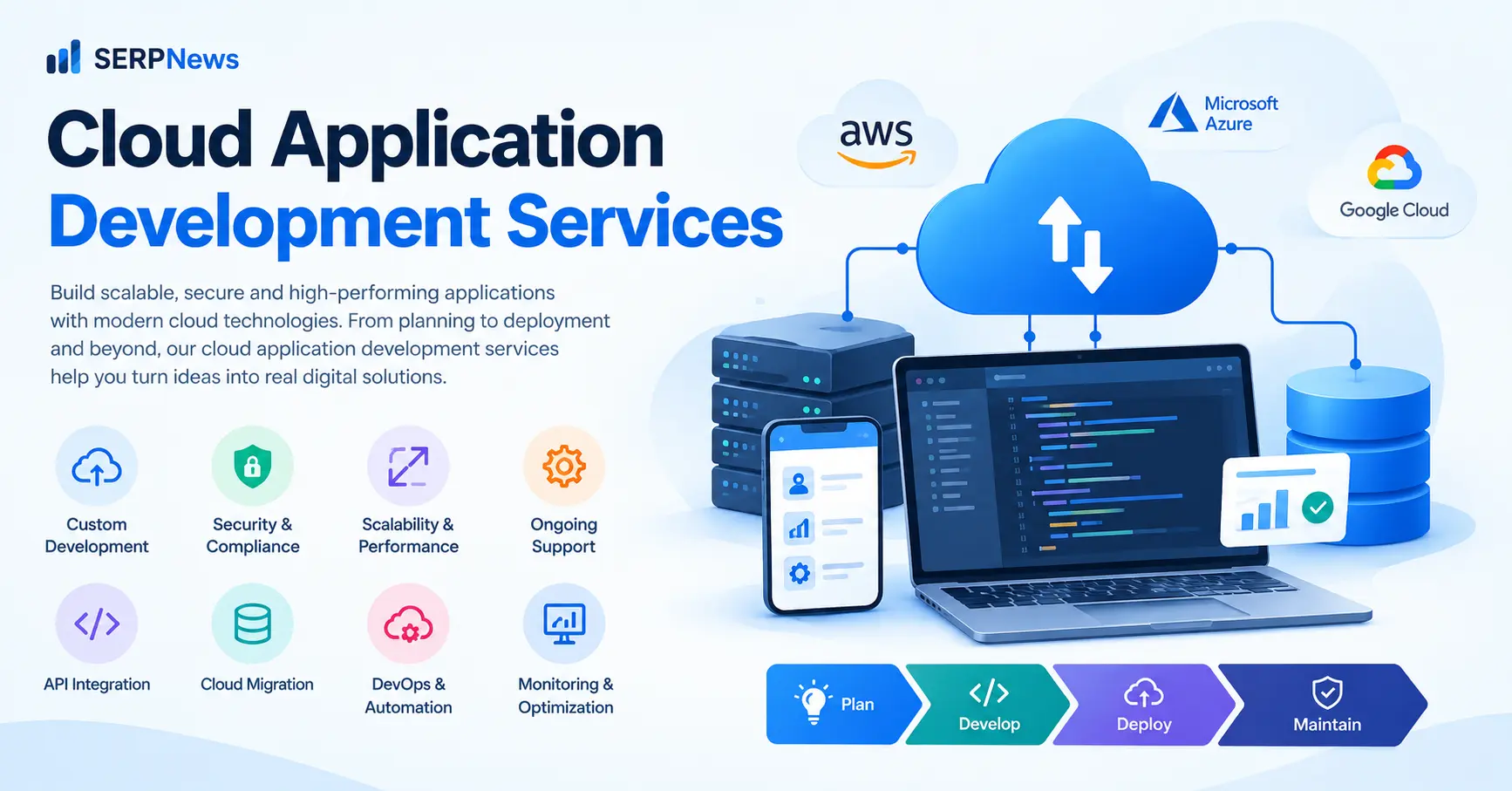
Cloud Application Development Services are professional development solutions used to create applications specifically designed to operate within cloud environments. These services can cover the complete development lifecycle, including planning, architecture, programming, testing, deployment, monitoring, optimization, and ongoing maintenance.
A cloud application may run entirely in the cloud or use a hybrid architecture that connects cloud resources with existing systems. For example, a company could keep certain legacy databases on private infrastructure while hosting its customer-facing application and analytics services in the cloud.
Modern Cloud Application Development Services generally focus on creating applications that can respond efficiently to changing workloads. Instead of purchasing physical infrastructure for the maximum expected demand, businesses can design systems that scale resources according to actual requirements.
This approach can be particularly useful for organizations experiencing unpredictable traffic. An online store, for example, may require significantly more computing resources during a major promotion than it does during an ordinary weekday.
Why Businesses Use Cloud Application Development
The growth of cloud computing has changed how companies approach application infrastructure. Traditional applications often require businesses to plan hardware capacity, maintain physical servers, manage upgrades, and handle infrastructure expansion themselves.
Cloud-based development can reduce some of these infrastructure responsibilities and give development teams access to a wider range of managed services. The exact benefits depend on the architecture and cloud provider, but several advantages are common.
Scalability
Scalability is one of the major reasons organizations consider Cloud Application Development Services. A well-designed application can increase or decrease computing resources based on workload requirements.
For example, imagine a ticketing platform that normally handles 2,000 concurrent users but expects 20,000 users during a major event. A cloud architecture can be designed to handle this increase using load balancing, additional application instances, caching, and other scaling mechanisms.
Scalability does not happen automatically simply because an application is hosted in the cloud. Developers still need to design the application and infrastructure correctly.
Flexibility
Cloud environments provide developers with access to different databases, storage systems, APIs, analytics tools, messaging services, and computing options. This allows teams to select technologies according to the application’s requirements rather than building every infrastructure component from scratch.
Faster Development
Managed cloud services can reduce the amount of infrastructure engineering required for common functions. Development teams can use managed databases, object storage, authentication services, queues, monitoring tools, and deployment platforms where appropriate.
This can allow developers to spend more time working on application functionality and user experience.
Global Availability
Applications serving customers in multiple geographic regions can use cloud infrastructure distributed across different locations. Properly designed systems can place application resources closer to users, potentially improving responsiveness and availability.
However, geographic distribution introduces additional considerations such as data residency, compliance, synchronization, and infrastructure cost.
How Cloud Application Development Works
Cloud Application Development Services usually follow a structured lifecycle. The exact process varies according to the application, but successful projects generally begin with requirements and architecture rather than immediately writing code.
1. Requirements and Planning
The first stage is understanding what the application needs to accomplish. Developers and stakeholders typically identify users, business processes, integrations, expected traffic, data requirements, security needs, and performance objectives.
A useful planning document can define requirements such as:
- Expected number of users
- Core application features
- Data storage requirements
- Third-party integrations
- Authentication requirements
- Expected traffic patterns
- Availability objectives
- Regulatory requirements
- Budget limitations
Clear requirements reduce the risk of building an application that works technically but fails to solve the intended business problem.
2. Cloud Architecture Design
Architecture determines how different parts of the application communicate and where they operate. Depending on the project, developers may choose a monolithic, modular, microservices, serverless, containerized, or hybrid architecture.
The right choice depends on application complexity and operational requirements. A small internal application does not necessarily need dozens of microservices, while a large platform with independent teams and high traffic may benefit from greater service separation.
3. Development
During development, programmers create the application’s frontend, backend, APIs, databases, authentication systems, and integrations.
Cloud Application Development Services may involve technologies such as containers, managed databases, serverless functions, REST APIs, GraphQL, message queues, object storage, and automated deployment pipelines.
The technology stack should be selected based on project requirements rather than popularity alone.
4. Testing
Testing should cover more than whether individual features work. Cloud applications also need performance, security, integration, compatibility, and failure testing.
For example, developers may test what happens when a database becomes temporarily unavailable, an API returns an error, traffic increases suddenly, or a cloud service reaches a configured limit.
5. Deployment
Once the application passes testing, it can be deployed to the target cloud environment. Modern development teams often use CI/CD pipelines to automate parts of building, testing, and deployment.
Automated deployment can reduce repetitive manual work and make it easier to release controlled updates.
6. Monitoring and Maintenance
Deployment is not the end of Cloud Application Development Services. Applications need ongoing monitoring to identify errors, unusual traffic, slow database queries, infrastructure problems, and security events.
Regular updates are also necessary because application dependencies, cloud services, operating environments, and security requirements change over time.
Types of Cloud Applications
Cloud Application Development Services can be used to build many different application types. Understanding the intended application category helps determine architecture and infrastructure requirements.
SaaS Applications
Software-as-a-Service platforms deliver software through the internet rather than requiring every customer to install and maintain the application locally.
Examples include project management platforms, accounting systems, customer relationship tools, collaboration software, and specialized business applications.
SaaS applications often require multi-tenant architecture, subscription management, authentication, usage tracking, billing integration, and strong data isolation.
E-Commerce Applications
Cloud environments can support online stores that need to manage product catalogs, customers, payments, orders, inventory, and marketing campaigns.
E-commerce systems also benefit from caching and scalable infrastructure because traffic can change significantly during sales and seasonal events.
Business Applications
Companies can use cloud applications for internal workflows such as employee management, reporting, document processing, inventory control, scheduling, and customer support.
These applications often need integration with existing enterprise systems.
Mobile Application Backends
Mobile apps frequently depend on cloud services for authentication, data storage, notifications, file storage, APIs, analytics, and synchronization.
The mobile application may be installed on a user’s device while its backend services operate within a cloud environment.
Cloud Application Architecture Explained
A typical cloud application can contain several interconnected layers. Understanding these layers makes it easier to identify performance and security requirements.
The presentation layer handles what users see and interact with. This might be a web interface, mobile application, or administrative dashboard.
The application layer contains business logic and APIs. It processes requests, applies rules, communicates with other services, and returns results.
The data layer manages application information through databases, object storage, caching systems, or other data services.
Infrastructure and platform services sit underneath these layers and provide computing, networking, monitoring, security, and deployment capabilities.
A simplified architecture might look like:
User
  ↓
Web / Mobile Interface
  ↓
Load Balancer
  ↓
Application / API Services
  ↓
Cache + Message Queue
  ↓
Database + Object Storage
  ↓
Monitoring / Security / Backup
This is only a conceptual model. Real applications can be considerably more complex, especially when they serve millions of requests or operate across multiple regions.
Cloud Security Considerations
Security should be designed into Cloud Application Development Services from the beginning rather than added immediately before launch.
Cloud security involves multiple layers. Application developers are responsible for secure code and application behavior, while cloud providers secure the underlying infrastructure according to their service models.
Identity and Access Management
Users and internal systems should receive only the permissions they require. Strong authentication, role-based access control, secure credentials, and appropriate service permissions can reduce unnecessary exposure.
Data Protection
Sensitive information should be protected both during transmission and when stored. Encryption, secure key management, appropriate access controls, backups, and retention policies should be considered during architecture planning.
Application Security
Developers should address common vulnerabilities such as injection attacks, insecure authentication, broken access controls, exposed secrets, unsafe dependencies, and improper input validation.
Security testing should also continue after deployment because new vulnerabilities can appear as technologies and dependencies change.
Cloud Application Development Services vs Traditional Development
Cloud development and traditional application development are not completely separate concepts. Both require programming, databases, testing, security, and maintenance, but their infrastructure models can differ significantly.
| Factor | Cloud Application Development | Traditional Infrastructure |
|---|---|---|
| Infrastructure | Cloud-based resources | Physical or privately managed servers |
| Scaling | Can be highly flexible | Often requires hardware planning |
| Deployment | Frequently automated | May involve more manual infrastructure work |
| Managed services | Widely available | Usually more infrastructure responsibility |
| Global deployment | Generally easier to configure | May require additional infrastructure |
| Cost model | Often usage-based | Often includes upfront infrastructure costs |
| Maintenance | Shared between provider and customer | More infrastructure responsibility |
Neither approach is automatically correct for every business. Highly regulated organizations, legacy environments, and applications with specialized infrastructure requirements may still need private or hybrid architectures.
How Much Do Cloud Application Development Services Cost?
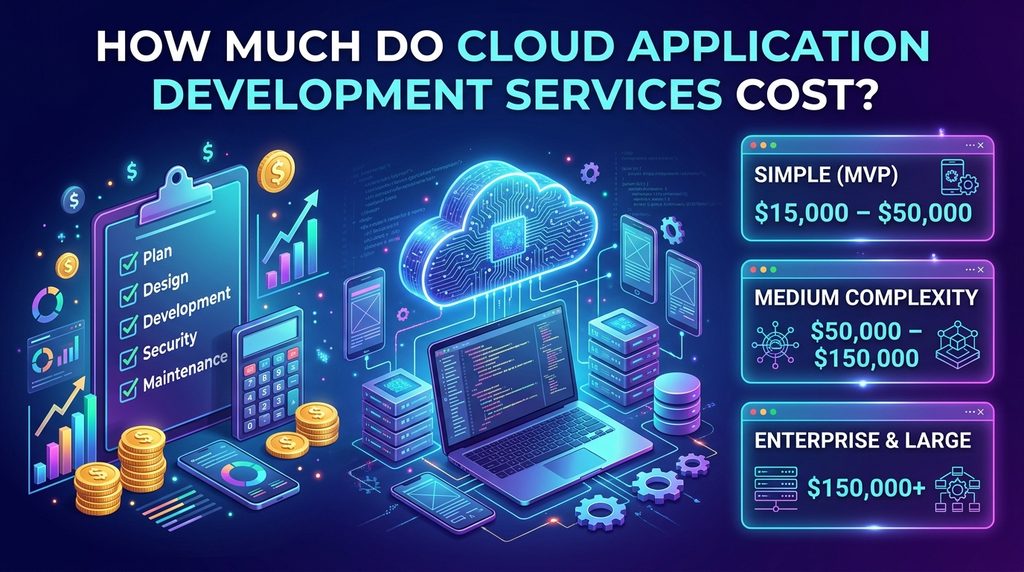
There is no universal price for Cloud Application Development Services because development costs depend on application complexity and operational requirements.
A simple internal application with a few workflows may require considerably less development effort than a multi-tenant SaaS platform with billing, analytics, mobile applications, integrations, and complex security controls.
The total project cost can be influenced by:
- Number of application features
- Design and user experience requirements
- Backend complexity
- Database architecture
- Third-party integrations
- Authentication and authorization
- Cloud infrastructure
- Testing requirements
- Compliance requirements
- Ongoing maintenance
- Expected traffic and storage
Cloud infrastructure itself can also create recurring costs. A common mistake is to estimate development expenses while ignoring the application’s monthly computing, database, storage, networking, monitoring, backup, and third-party service usage.
A good architecture therefore considers cost optimization before deployment, not after the monthly bill becomes unexpectedly high.
Common Cloud Development Mistakes
Even technically strong teams can make mistakes when designing cloud applications. Identifying these issues early can save development time and infrastructure costs.
Choosing Microservices Too Early
Microservices can provide useful benefits, but they also introduce operational complexity. A small application may be easier to maintain as a modular monolith rather than immediately splitting everything into independent services.
Ignoring Observability
An application can appear healthy while individual services experience increasing latency or error rates. Logging, metrics, tracing, alerts, and dashboards help teams understand what is happening in production.
Poor Cost Management
Unused resources, excessive storage, inefficient database queries, unnecessary data transfer, and oversized infrastructure can increase cloud expenses.
Cost monitoring should therefore be part of normal application management.
Weak Backup Planning
Cloud hosting does not automatically mean every piece of application data is permanently recoverable. Businesses should define backup frequency, retention, restoration procedures, and recovery objectives.
How to Choose Cloud Application Development Services
When evaluating a development provider, businesses should look beyond a portfolio of attractive screenshots. The more useful questions concern architecture, security, communication, testing, deployment, and long-term support.
Ask potential providers:
- What cloud architecture do you recommend and why?
- How will the application scale as users increase?
- How will sensitive data be protected?
- What testing process will be followed?
- How will cloud costs be monitored?
- Who will maintain the application after launch?
- How will backups and disaster recovery work?
- What documentation will be delivered?
- How will third-party integrations be managed?
- What happens if the application needs to migrate to another environment?
A reliable provider should be able to explain technical decisions in business terms. If every recommendation is based on using more infrastructure or more complex technology without a clear requirement, that deserves closer examination.
Future Trends in Cloud Application Development
Cloud Application Development Services continue to evolve as organizations adopt new approaches to software development and infrastructure management.
Serverless computing is becoming useful for workloads where developers want to run functions without managing traditional application servers. Containers remain popular for packaging applications consistently across development and production environments.
Artificial intelligence is also influencing cloud application architecture. Modern applications may use cloud-hosted machine learning models, AI APIs, vector databases, retrieval systems, and automated data processing pipelines.
At the same time, security and cost optimization are becoming increasingly important. Businesses are learning that successful cloud development is not simply about moving applications to the cloud. It is about creating an architecture that balances performance, reliability, security, maintainability, and cost.
FAQ About Cloud Application Development Services
What are Cloud Application Development Services?
Cloud Application Development Services include planning, designing, developing, testing, deploying, and maintaining applications that operate using cloud infrastructure and services.
Why are cloud applications useful for businesses?
Cloud applications can provide flexible infrastructure, easier scaling, managed services, and access from different locations. The actual benefits depend on how the application is designed and managed.
How long does cloud application development take?
Development time depends on the application’s scope. A small business application may take weeks or a few months, while a complex SaaS or enterprise platform can require many months of design, development, testing, and deployment.
Are cloud applications secure?
Cloud applications can be secure when developers implement appropriate authentication, authorization, encryption, secure coding, monitoring, backups, and vulnerability management. Hosting an application in the cloud does not automatically make it secure.
Which cloud platform should a business choose?
The choice depends on application requirements, existing technology, team expertise, geographic needs, compliance requirements, available services, and budget. There is no single cloud platform that is ideal for every application.
Can an existing application be moved to the cloud?
Yes, many existing applications can be migrated to cloud infrastructure. Depending on the application’s architecture, the process may involve simple hosting changes, modernization, containerization, database migration, or partial redevelopment.
How can cloud application costs be controlled?
Businesses can control costs through appropriate resource sizing, monitoring, automated scaling, storage policies, efficient databases, removal of unused resources, and regular cost reviews.
Conclusion
Cloud Application Development Services provide businesses with a flexible approach to building modern digital applications. From SaaS platforms and e-commerce systems to mobile backends and internal business tools, cloud architecture can support applications with changing workloads and evolving requirements.
However, successful cloud development is about more than selecting a cloud provider. Architecture, application design, security, testing, observability, scalability, data management, and cost optimization all influence the long-term performance of a cloud application.
For businesses considering Cloud Application Development Services, the strongest approach is to start with clear requirements and a practical architecture, then select technologies that solve the actual problem. When cloud infrastructure is combined with disciplined development and continuous monitoring, organizations can build applications that are easier to scale, maintain, and improve over time.
