

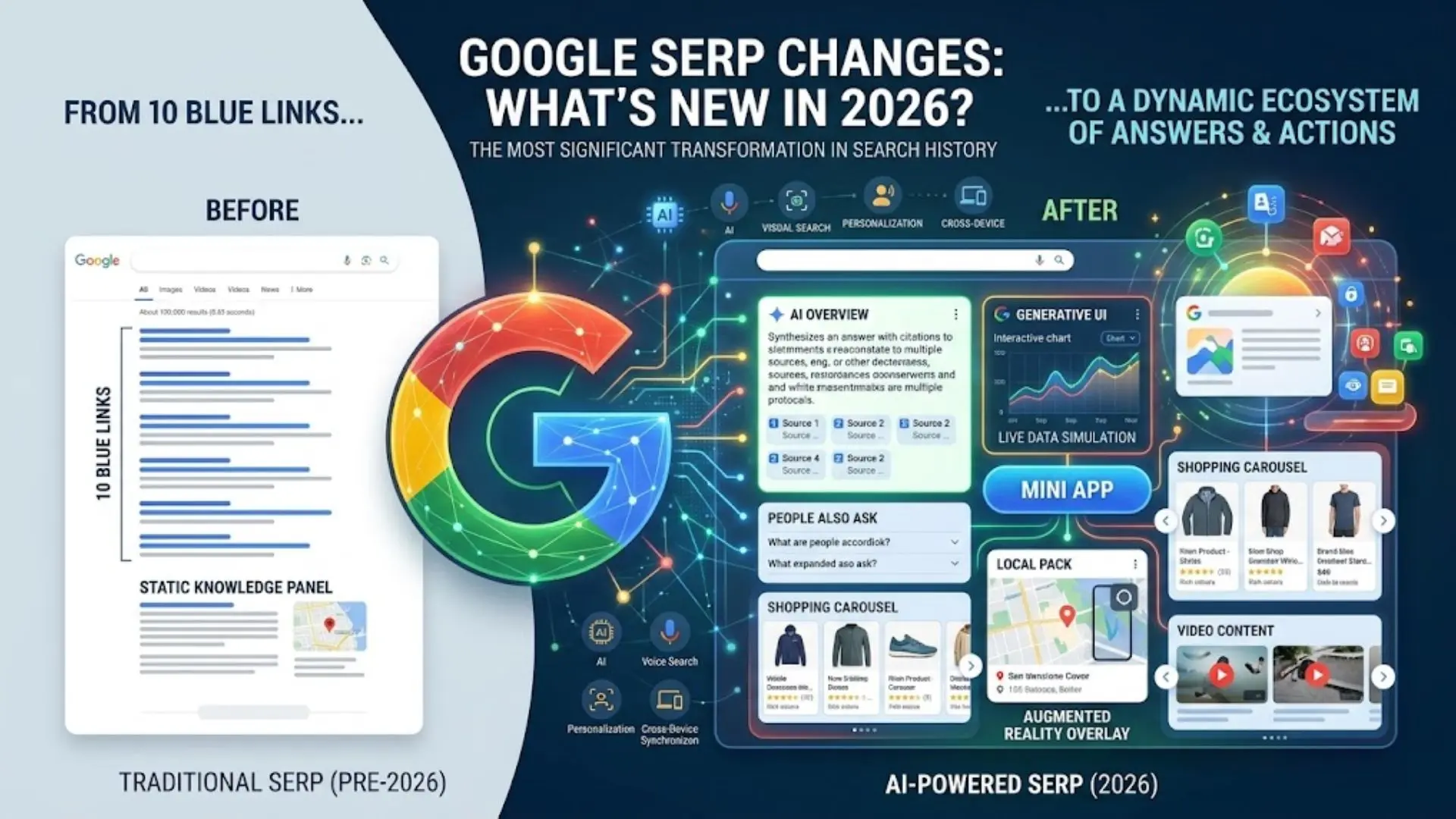
You search your own keyword and suddenly the page looks nothing like the one you checked last week. An AI answer sits at the top, a People Also Ask box pushes organic results down, and your click-through rate falls even though your ranking barely moved.
That’s the reality behind Google SERP Changes in 2026.
Google’s search results are no longer just ten blue links. AI Overviews, AI Mode, featured snippets, videos, images, shopping results, local results, discussions, ads, and traditional organic listings can all compete for the same screen.
For SEO teams, that creates a bigger question than “What position am I ranking at?”
What does the entire search result look like, and how much visibility does my page actually receive?
This guide breaks down the major Google SERP Changes in 2026, what they mean for rankings and traffic, how AI is changing the results page, and what you should monitor before changing your SEO strategy.
What Are the Biggest Google SERP Changes in 2026?
Google SERP Changes in 2026 are being driven by AI search features, algorithm updates, changing SERP layouts, richer search features, and new ways of measuring visibility. The result is a search page where organic ranking is still important, but it no longer tells the complete story.
Google’s March and May 2026 core updates produced meaningful ranking movement, while Google’s AI search experience continues to expand. Search Engine Land reported that the May 2026 core update was Google’s second core update of the year, following the March update.
At the same time, Google has continued adding AI-driven search experiences and new reporting capabilities.
That means publishers need to watch two things at once:
- How Google’s ranking systems change
- How the search results page itself changes
Those aren’t always the same thing.
The biggest changes to watch
| Change | SEO impact | What to monitor |
|---|---|---|
| AI Overviews | More answer-first searches | Citations and organic clicks |
| AI Mode | More conversational discovery | Brand and page visibility |
| Core updates | Ranking volatility | Page-level traffic and queries |
| SERP features | Less space for classic listings | Feature ownership |
&num=100 change | Deeper rank tracking became harder | Tool methodology |
| Search Console AI reporting | New visibility data | AI impressions and clicks |
| Rich media results | More competition for attention | Images, videos and news |
| Search intent shifts | Different pages can win | SERP composition |
The modern SEO question isn’t only “Did my ranking change?” It’s “What changed on the SERP?”
Why Google SERP Changes Can Reduce Traffic Without Lowering Rankings
Google SERP Changes can reduce organic traffic even when your position stays the same because other search features may occupy more attention above or around your listing. A page ranking fourth today may receive less traffic than a page ranking fourth several months ago if the SERP has become more crowded.
Imagine your page ranks in position four.
Above it, the searcher now sees:
- An AI Overview
- Sponsored results
- A featured result
- A People Also Ask box
Your ranking didn’t necessarily fail.
Your available click space changed.
This is why SEO reporting needs more than average position.
Track visibility as a complete picture
A useful report should combine:
- Average position
- Impressions
- Click-through rate
- Organic clicks
- SERP features
- AI visibility
- Branded searches
- Non-branded searches
- Conversions
Search Console is particularly useful because it shows how your actual pages perform for real queries.
A rank tracker can tell you that a keyword moved from position three to four. Search Console can help you understand whether that movement actually reduced impressions or clicks.
That difference matters.
Don’t confuse lower CTR with a ranking penalty
A CTR decline can happen because:
- A new SERP feature appeared
- Search intent changed
- More ads appeared
- A competitor gained a stronger result
- AI answered part of the query
- Your title became less attractive
- The query mix changed
So before rewriting the entire article, inspect the SERP.
A ranking report tells you where you are. A SERP analysis tells you why the traffic changed.
How AI Overviews Are Changing the Google SERP
AI Overviews are changing the top of Google’s results by giving users a generated answer alongside links to supporting sources. This creates a new visibility layer for publishers because a page can potentially appear as a cited source even when the user doesn’t interact with a traditional organic result first.
Google’s documentation says AI features are built into its existing Search systems and that websites don’t need a separate technical markup or special AI-only optimization method to qualify. Normal SEO fundamentals still matter.
That’s an important point.
You don’t need to create a completely separate “AI SEO” website.
You need content that is:
- Crawlable
- Indexable
- Useful
- Specific
- Original
- Well structured
- Supported by trustworthy sources
- Easy to understand
AI Overviews change the value of informational queries
Consider a query such as:
“What is a SERP?”
A user may now receive a direct explanation before deciding whether to visit a website.
But a more specific query such as:
“How do Google SERP changes affect rank tracking in 2026?”
requires deeper explanation, evidence, comparisons, and practical advice.
That’s where detailed publisher content has more room to compete.
Your goal shouldn’t be to make every page longer.
Your goal should be to make each page more useful than the short answer already available on the SERP.
What makes content useful for AI-era search?
Strong pages tend to provide information that is difficult to replace with a generic summary:
- First-hand observations
- Original research
- Screenshots
- Examples
- Comparisons
- Expert interpretation
- Updated statistics
- Clear source attribution
- Specific recommendations
Google’s 2026 guidance continues to emphasize useful, unique content rather than mass-produced pages created mainly to capture search variations.
If an AI can summarize your entire article in two sentences without losing anything important, your article probably needs a stronger original angle.
What Happened to Google’s &num=100 SERP Parameter?
Google’s 2025 &num=100 change affected how SEO platforms collected deeper search results, making positions beyond the first page harder and more expensive for some systems to retrieve. Ahrefs documented the change in September 2025 and later reported that it was working to restore access to deeper results across its products.
Semrush similarly explained that Google’s change removed the old ability to display 100 results on one page, while its Top 10 and Top 20 reporting remained available.
This distinction is important.
The &num=100 change was not a ranking penalty
If your SEO platform suddenly reported fewer keywords, that didn’t automatically mean Google removed those keywords from its index.
The issue was partly about data collection.
SEO tools depend on systems that collect and process SERPs at scale. When Google changes how results are exposed, those tools may need to change their collection methods.
That can affect:
- Keyword counts
- Historical comparisons
- Deep ranking reports
- Competitor visibility reports
- Rank-tracking costs
- SERP API workflows
Ahrefs’ current algorithm history also lists the September 2025 &num=100 change as an industry-wide SERP data issue.
What should SEO teams do?
Don’t abandon rank tracking.
Instead, give more weight to the rankings that actually matter.
Track:
- Top 3 keywords
- Top 10 keywords
- Revenue-driving queries
- High-intent terms
- Important landing pages
- Search Console impressions
- Organic clicks
- Conversions
For deeper positions, use the data carefully and understand how your tool collects it.
Better reporting beats bigger keyword lists.
Which Google SERP Features Matter Most in 2026?
Google SERP Changes have made feature visibility a major part of SEO. AI Overviews, questions, sitelinks, knowledge features, videos, images, local results, shopping and traditional snippets can all affect how much attention an organic listing receives.
Ahrefs analyzed one million US desktop SERPs in 2025 and found substantial growth in AI Overview visibility between January and June, while traditional featured snippets declined in its dataset.
The exact percentages will change over time, but the larger lesson is more important:
SERP features are not static.
The features worth tracking
| SERP feature | Best opportunity | Main SEO action |
|---|---|---|
| AI Overview | Source citation | Create original, well-supported content |
| Featured snippet | Direct answer | Structure concise answers |
| People Also Ask | Question visibility | Cover related questions |
| Video | Visual discovery | Create useful demonstrations |
| Images | Visual search | Optimize relevant images |
| Local pack | Local intent | Strengthen local signals |
| Shopping | Product intent | Improve product data |
| Discussions | Community queries | Address real user concerns |
| Sitelinks | Brand navigation | Improve site structure |
You don’t need to target every feature.
Start with the features that repeatedly appear for your most valuable queries.
How to find your SERP opportunity
Search your target keyword manually.
Then ask:
What is Google rewarding on this page?
If the results are mostly long guides, your content needs depth.
If they are mostly product pages, an informational article may struggle.
If videos dominate, consider adding a video.
If PAA appears repeatedly, build question-focused subsections.
If local results dominate, don’t expect a generic national article to win easily.
This is search intent analysis in practice.
How Google’s 2026 Core Updates Are Affecting Search Results
Google’s 2026 core updates have created another layer of SERP volatility. Google released a March 2026 core update and then a May 2026 core update, with the May rollout beginning May 21 and completing in early June.
Core updates can change rankings across many types of queries.
But there’s an important mistake to avoid.
Don’t assume every traffic drop means a penalty
A core update can change which pages Google considers most relevant or satisfying for a query.
That doesn’t necessarily mean your website received a manual penalty.
Your competitors may simply have become stronger matches for the search intent.
For example, imagine you rank well for:
“best SERP tracking tools.”
After an update, Google may decide that users prefer comparison pages with pricing, screenshots and product testing.
If your article only explains what SERP tracking means, your ranking can fall even if the writing is technically good.
The problem is not necessarily “bad content.”
It may be content-query mismatch.
What to check after a core update
When traffic changes during or after a core update:
- Compare affected pages.
- Check the queries losing clicks.
- Review the current SERP.
- Compare the winning pages.
- Identify changed search intent.
- Look for missing information.
- Improve the page only where evidence supports it.
Don’t rewrite everything on day one.
Wait until the rollout finishes, then analyze the pattern.
Search Engine Land reported that the March 2026 core update was particularly volatile, with significant movement among top results.
The strongest post-update response is diagnosis, not panic.
Why Search Intent Matters More After SERP Changes
Search intent tells Google what type of result is most likely to satisfy the searcher. When the SERP changes, the mix of ranking pages often reveals that Google has changed or refined what it considers useful for the query.
There are four basic intent groups:
| Intent | Example | Likely winning content |
|---|---|---|
| Informational | What is a SERP? | Guide |
| Commercial | Best SERP tools | Comparison |
| Transactional | Buy SEO software | Product/service page |
| Navigational | Ahrefs login | Official page |
But real searches can be mixed.
Someone searching:
“Google SERP changes 2026”
probably wants information.
But they may also want to know:
- Whether their rankings changed
- Which SEO tools were affected
- What happened to AI visibility
- How to monitor SERPs
- Whether they need to update their strategy
That’s why a page targeting this keyword shouldn’t stop at a definition.
It needs explanation and practical action.
Let the SERP define the content format
Before writing a new page, examine the top results.
If most results contain:
- Timelines → add a timeline
- Tables → add a useful comparison
- Case studies → provide examples
- Tools → show how to use them
- FAQs → answer specific questions
- News updates → provide dates and source verification
The SERP is effectively telling you what users expect.
Don’t fight the search intent. Study it, then make the result better.
How to Diagnose a Sudden Google Ranking Drop
A sudden ranking drop should be investigated across rankings, traffic, indexing, technical issues, search intent and SERP changes. The fastest way to find the cause is to compare several signals instead of relying on one SEO tool.
Start with these questions.
Did impressions fall?
If impressions fell, your page may be appearing for fewer searches.
Did CTR fall?
If impressions stayed similar but clicks fell, inspect the SERP layout and title.
Did rankings fall?
Check several sources and the actual Google result.
Did competitors replace you?
Compare the pages now ranking above yours.
Did the query intent change?
Look at the current results.
Did Google release an update?
Check Google’s Search Status Dashboard and trusted SEO reporting.
Did your page have a technical problem?
Check:
- Indexing
- Robots directives
- Canonicals
- Server status
- Page availability
- Internal links
- Mobile rendering
This creates a simple diagnostic matrix:
| Symptom | Possible cause |
|---|---|
| Rankings down + impressions down | Visibility loss |
| Rankings stable + CTR down | SERP/layout change |
| Rankings stable + impressions down | Query demand or SERP change |
| Rankings down + competitors up | Intent/content shift |
| Tool data down suddenly | Measurement issue |
| Traffic down after update | Algorithm/content reassessment |
Don’t jump straight to content rewriting.
First identify the actual problem.
How Internal Linking Can Help Your Site Respond to SERP Changes
Internal linking helps search engines discover related content and understand the relationship between pages. For a SERP-focused website, strong internal linking can turn individual articles into a connected topical resource instead of isolated posts.
This is particularly important for SERP News.
Your existing content can support a larger search-intelligence cluster.
A logical structure would look like:
SERP Guide
↓
Google SERP Changes
↓
SERP Features
↓
SERP Extraction
↓
SERP Reports
↓
Google Algorithm Updates
↓
AI Search
Each article should link naturally to the others where the reader needs more information.
Example internal links for this article
From the introduction, link to your existing What Is a SERP? guide.
When discussing data collection, link to your SERP Extraction Tool article.
When comparing search engines, link to your Bing SERP Reports article.
When discussing SERP features, link to the site’s dedicated SERP Features content.
This creates a clear topic relationship.
It also gives readers somewhere useful to go after finishing one article.
A good internal link answers the reader’s next question before they have to search for it.
What E-E-A-T Should a SERP News Website Build?
E-E-A-T matters for SERP and SEO publishing because readers need to know who produced the information, how claims were verified, and whether the article reflects current search conditions.
For a site covering Google updates, simply saying “we are experts” isn’t enough.
Show the work.
Use named authors
Each article should have:
- A real author
- A short expertise bio
- An author profile
- Published article history
- Relevant professional profiles
- An editor or reviewer where appropriate
Cite primary sources
When Google announces an update, link to Google.
When an SEO platform reports a measurement change, identify that platform.
When you run your own observation, label it as an observation.
This creates a clear distinction between:
Confirmed fact
and
Industry interpretation
and
Our own observation
That distinction is especially useful for SEO news.
Add editorial transparency
SERP News should consider publishing an editorial methodology explaining:
- How Google updates are verified
- How SERP screenshots are collected
- How dates are checked
- How third-party claims are reviewed
- How corrections are handled
- How AI-assisted material is fact-checked
This can become a real trust asset.
For SEO news, showing how you know something is almost as important as saying what happened.
How to Monitor Google SERP Changes Without Wasting Time
The most useful SERP monitoring system focuses on high-value queries instead of checking thousands of keywords every hour. Combine rank-tracking data with Search Console, live SERP reviews and business outcomes.
Step 1: Create a priority keyword set
Divide keywords into:
- Brand
- Commercial
- Informational
- High-conversion
- Strategic topics
- Competitor terms
Step 2: Record SERP features
For each important query, note whether you see:
- AI Overview
- PAA
- Featured snippet
- Video
- Images
- Local pack
- Shopping
- News
- Discussions
Step 3: Record rankings
Track the important organic positions.
Don’t obsess over every keyword.
Step 4: Compare Search Console
Look at:
- Impressions
- Clicks
- CTR
- Average position
- Queries
- Landing pages
Step 5: Review the actual SERP
This is the step many automated reports miss.
Search the query yourself.
Look at the page.
Ask:
What changed?
Step 6: Connect it to business results
A ranking change matters more when it changes:
- Leads
- Sales
- Signups
- Subscribers
- Qualified traffic
This produces a better SEO dashboard than a simple “keywords won” number.
Google SERP Changes vs Traditional Rank Tracking
Traditional rank tracking still matters, but it can’t fully represent the modern SERP. Google SERP Changes have made SERP features, AI visibility, CTR and actual traffic increasingly important alongside position.
Think of SEO measurement as four layers:
Layer 1: Ranking
Where does the page appear?
Layer 2: SERP visibility
How much attention does the page receive?
Layer 3: Search visibility
Does the brand or page appear in AI features, questions, videos or other surfaces?
Layer 4: Business value
Does that visibility create meaningful traffic or conversions?
This model helps explain why two sites ranking in the same position can have completely different outcomes.
Position is a measurement. Visibility is an experience. Revenue is the result.
What Google SERP Changes Mean for Content Writers
Google SERP Changes are changing what good SEO writing looks like. Writers can no longer rely on keyword placement and generic explanations when the SERP itself provides instant answers.
A strong article needs a reason to exist.
For content writers, that means:
Add first-hand information
If you tested a tool, say what happened.
If you monitored a SERP, explain the observation.
If you compared results, show the comparison.
Add original examples
Don’t write:
“SERPs change frequently.”
Show what that means.
For example:
A query might have a featured snippet on Monday, an AI Overview on Wednesday, and a different PAA layout on Friday.
That example makes the concept real.
Answer the follow-up question
A user rarely asks only one question.
If they search:
“What are Google SERP Changes?”
their next questions may be:
- Why did my traffic fall?
- Did Google update the algorithm?
- Are AI Overviews responsible?
- How do I track changes?
- Should I update my content?
A strong page answers those questions naturally.
Don’t pad word count
Longer isn’t automatically better.
If a competitor explains something in 1,500 words, don’t write 3,000 words by repeating the same point.
Add:
- Better examples
- Better data
- Better structure
- Better explanations
- Better source verification
- Better practical advice
That’s how you make additional words useful.
The Biggest Google SERP Mistakes SEO Teams Should Avoid
Google SERP Changes become much easier to handle when you avoid the most common reporting mistakes.
Mistake 1: Watching only position
A stable ranking can still lose clicks.
Mistake 2: Treating every movement as an algorithm penalty
Many ranking changes are normal.
Mistake 3: Ignoring SERP features
The result page can change dramatically without your URL moving.
Mistake 4: Trusting one SEO tool blindly
Different platforms collect and model SERPs differently.
Mistake 5: Updating content before diagnosing the problem
You may fix something that isn’t broken.
Mistake 6: Ignoring search intent
The winning content format can change.
Mistake 7: Publishing without first-hand value
Generic summaries are easier to replace.
Mistake 8: Leaving internal links until the end
Internal linking should be part of the content architecture from the beginning.
A Practical 30-Day Google SERP Changes Action Plan
You don’t need a massive SEO project to start responding to Google SERP Changes. A focused 30-day audit can reveal where your site is losing visibility and where new opportunities are appearing.
Days 1–7: Build your SERP baseline
Choose your 20–50 most valuable keywords.
Record:
- Position
- CTR
- Impressions
- SERP features
- Competitors
- Search intent
Days 8–14: Find SERP gaps
Look for queries where:
- Your page ranks but receives weak CTR
- Competitors have stronger content
- AI features dominate
- PAA questions are unanswered
- Video or image results dominate
- Your content format doesn’t match the SERP
Days 15–21: Improve the site structure
Add internal links between related articles.
Create supporting content around missing subtopics.
Strengthen author information.
Add primary-source citations.
Days 22–30: Measure again
Compare:
- Rankings
- Impressions
- CTR
- Clicks
- Conversions
- SERP feature visibility
Don’t expect every improvement immediately.
The goal of the first month is to build a repeatable process.
What Should SEO Professionals Expect From Google SERPs Next?
The direction is clear: Google search is becoming more interactive, more visual and more AI-assisted. Traditional organic results aren’t disappearing, but they increasingly share the page with other ways of answering a query.
That means future-proof SEO will focus less on one ranking number and more on being useful across the search experience.
For publishers, that means building original resources.
For brands, it means building recognizable entities and trustworthy information.
For SEO teams, it means measuring visibility from multiple angles.
And for content writers, it means producing information that has value beyond a short AI-generated summary.
Google’s 2026 search environment rewards teams that pay attention to both sides of the equation:
How the algorithm ranks pages — and how the searcher experiences the SERP.
Frequently Asked Questions About Google SERP Changes
What are Google SERP Changes?
Google SERP Changes are changes to Google’s search results layout, ranking systems, SERP features, AI search experiences, or the way results are collected and measured.
Why does Google keep changing the SERP?
Google changes Search to improve how users find information and to introduce new result formats, including AI-assisted experiences and richer search features.
Did Google remove the &num=100 parameter?
Yes. Google changed the behavior of the old &num=100 parameter in September 2025, affecting how SEO tools collected deeper results.
Can AI Overviews reduce organic clicks?
They can change how users interact with traditional results. The actual impact varies by query, intent, SERP layout and the visibility of supporting links.
How do I check if Google changed my SERP?
Compare your rank data with Search Console, inspect the live SERP, check SERP features, and review Google’s update announcements.
Should I rewrite my article after a Google core update?
Not immediately. Wait for the rollout to finish, identify the affected queries, inspect the new SERP and compare the winning pages before making major changes.
What should I track besides keyword rankings?
Track impressions, clicks, CTR, conversions, SERP features, AI visibility, search intent and the pages appearing around your result.
Conclusion
Google SERP Changes aren’t something SEO teams can solve by watching a single ranking chart. The better approach is to understand the entire results page, verify changes with reliable sources, and connect visibility data with real business outcomes.
Start with your most valuable queries, inspect the live SERPs, and build content that gives searchers something they can’t get from a generic answer. That’s the strategy most likely to keep your site competitive as Google SERP Changes continue through 2026.
Take the Next Step
Audit your top 20 keywords this week. Record the complete SERP, compare it with Search Console, and identify one visibility gap you can fix with better content or internal linking.
